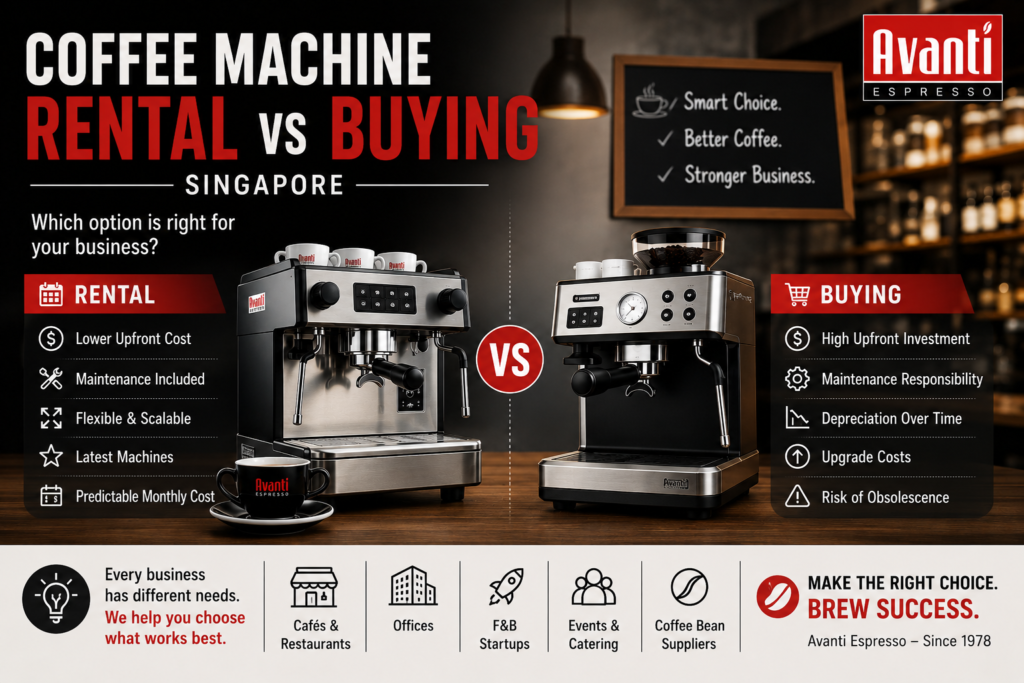
Avanti Espresso is a Singapore coffee bean and coffee machine supplier that has worked with cafés, restaurants, and offices since 1978, offering both purchase and rental paths for commercial espresso equipment. If you’re weighing coffee machine rental Singapore options against buying outright, the right answer depends less on your industry and more on three things: how long you’ll use the machine, how predictable your coffee volume is, and how much capital you want tied up in equipment. This guide compares coffee machines: rental in Singapore versus buying outright.
This guide breaks the decision down by business type, with a breakeven calculation you can actually use.
In this article
- What Does Coffee Machine Rental in Singapore Actually Include?
- Rental vs Buying: Quick Comparison
- The Real Numbers: What Machines Cost to Buy in Singapore
- When Renting Makes More Sense
- When Buying Outright Pays Off
- How to Calculate Your Breakeven Point
- Questions to Ask Before You Sign or Buy
- The Bottom Line
- Frequently Asked Questions
What Does Coffee Machine Rental in Singapore Actually Include?
Coffee machine rental in Singapore is a service contract where a supplier installs a commercial machine at your premises for a fixed monthly fee that typically covers maintenance, technical support, and sometimes bean supply, instead of a large upfront purchase. Most agreements run 12–24 months.
A standard automatic coffee machine rental package bundles installation, scheduled servicing, and breakdown support into one line item, which is why it appeals to businesses that don’t want to manage a maintenance contract themselves. Monthly fees generally sit between $150 and $600, scaling with machine capacity and group count. For a full breakdown of what’s typically bundled into a rental agreement — including bean-purchase minimums and loan-machine terms — see our detailed look at office coffee machine rental in Singapore.
Rental vs Buying: Quick Comparison
| Factor | Rental | Buying |
Upfront cost | Low to zero (deposit only) | $1,100–$25,900+ depending on model |
Monthly cost | $150–$600, all-inclusive | None (own it outright) |
Maintenance | Usually included | Your responsibility, $300–$800/year |
Contract length | 12–24 months typical | Permanent |
Best fit | New concepts, growing volume, events | Established, high-volume, stable sites |
Asset ownership | No | Yes — appears on your books |
The Real Numbers: What Machines Cost to Buy in Singapore
A commercial-grade machine purchase is a defined, one-time capital decision, and prices in Singapore’s market span a wide range depending on group count and automation level. On Avanti Espresso’s own range, a compact single-group unit like the Bravilor Bonamat filter machines starts around $1,100–$1,850, while multi-group traditional espresso machines from FAEMA — the Italian manufacturer Avanti has partnered with for 34 years — run from roughly $9,300 for the E98UP A2 up to $25,900 for the E71 Touch A2, depending on configuration.
That range matters because it directly shapes the breakeven math below: a $6,800 entry machine and a $22,000 flagship unit reach breakeven against rental at very different points.
When Renting Makes More Sense
Renting is the better fit when the coffee machine is one of several unknowns in your business, not the only one.
- F&B startups and pop-ups — Capital is scarce in the first 12–18 months. A rental keeps cash available for rent, staff, and inventory while still delivering café-quality output.
- Businesses testing a new concept or location — If you’re not certain the site will work, a 12-month rental contract is far easier to exit than a $15,000 asset you now need to resell.
- Corporate offices and events — Coffee is a perk, not the product. Predictable monthly cost and zero maintenance admin usually outweigh ownership. This is covered in depth in our automatic coffee machine rental guide (linked above).
- Rapidly scaling teams — If headcount or seat count could double within two years, a rental lets you upgrade machine capacity without writing off a depreciating asset.
When Buying Outright Pays Off
Buying tends to win once volume is stable and the time horizon is long enough for the upfront cost to be absorbed.
- Established cafés and restaurants with consistent daily volume — Once you know your cup count and it isn’t changing much, ownership removes the monthly fee ceiling and any bean-purchase minimums tied to a rental agreement.
- Businesses that want the machine as a balance-sheet asset — Purchased equipment can qualify for capital allowances under Singapore’s Income Tax Act, letting companies write off the cost against taxable income over time; see IRAS’s guide to capital allowances for how this works.
- Operations with in-house technical capability — If you already have a facilities or maintenance function, the “maintenance included” advantage of rental matters less.
- Multi-outlet operators — Buying in bulk across locations often brings per-unit pricing down further than any rental package would.
How to Calculate Your Breakeven Point
A breakeven calculation is simply the point where the total cost of renting overtakes the total cost of buying and maintaining the same machine — and it’s the single most useful number in this decision.
The formula: Machine purchase price ÷ (monthly rental rate − estimated monthly maintenance cost if owned) = breakeven point in months.
Worked example: A FAEMA Prestige A2 costs $11,500 to buy. Renting a comparable machine costs roughly $400/month, while owning it costs an estimated $50/month in averaged annual servicing ($300–$800/year, per general industry maintenance ranges). That’s a $350/month difference, so $11,500 ÷ $350 ≈ 33 months to breakeven. Run the same math with your actual quote and machine model before deciding — general lease-vs-buy equipment frameworks apply the same logic to equipment decisions generally, not just coffee machines.
If you’ll be using the machine well past your breakeven month, buying is usually cheaper overall. If you’re not sure you’ll hit that mark, rent.
Questions to Ask Before You Sign or Buy
Before committing either way, confirm:
- Is there a minimum monthly bean purchase tied to the rental rate, and what happens if you miss it?
- What’s the loan-machine policy if your rented unit needs off-site repair?
- For a purchase, what’s the manufacturer’s warranty period and where is servicing done locally?
- Can the rental contract be upgraded to a higher-capacity machine if volume grows?
- Does the volume you’re planning for match the right machine size for your business?
The Bottom Line
There’s no universally correct answer between coffee machine rental Singapore and buying — the right call depends on how confident you are in your volume and how long you plan to run it. New cafés, pop-ups, and offices generally do better renting first. Established, high-volume operators generally save more by owning.
Avanti Espresso has supplied coffee machines and premium espresso beans to Singapore businesses since 1978, with both purchase and lease options across its coffee machine range and a wholesale coffee beans programme to match. If you’re still weighing it up, get in touch and the team will help you run the numbers against your actual volume.
Frequently Asked Questions
Is it cheaper to rent or buy a coffee machine in Singapore?
It depends on how long you’ll use it. Renting is cheaper in the first 24–36 months because there’s no large upfront cost. Past that breakeven point, buying is usually cheaper over the machine’s working life.
How much does automatic coffee machine rental cost in Singapore?
Most automatic coffee machine rental packages in Singapore cost between $150 and $600 per month, depending on the machine’s capacity and what’s bundled in, such as maintenance and bean supply.
What’s included in an office coffee machine rental Singapore package?
A typical office coffee machine rental Singapore agreement includes installation, staff training, scheduled maintenance visits, and technical support. Some providers also bundle bean supply into the monthly fee.
Can I buy the machine after renting it?
Some providers offer a rent-to-own path, but it’s not standard across the market. Confirm this explicitly in your contract before signing if it’s a priority for you.
Do coffee machine rentals in Singapore require a minimum bean purchase?
Many do. A common structure ties the low rental rate to a monthly bean quota — often around 30kg — with the fee rising to $200–$500/month if you fall short. Always ask for this threshold in writing.
How long should a rental contract be before buying makes more sense?
If you expect to use the machine for more than roughly 2.5–3 years and your volume is stable, run the breakeven calculation — buying is very likely to cost less over that timeframe than continuing to rent.