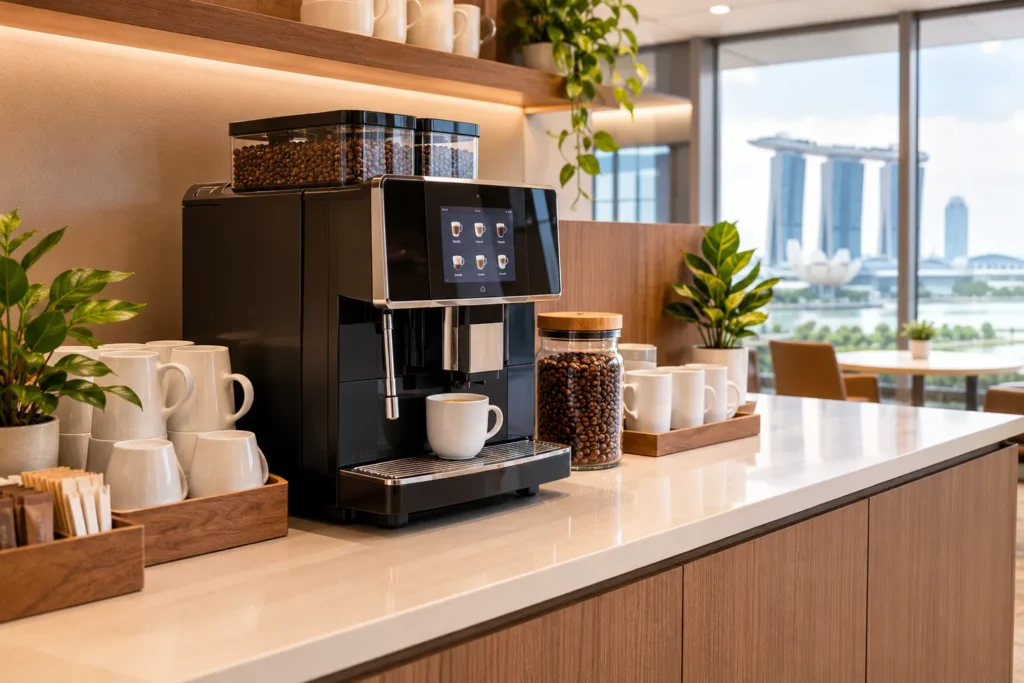
To set up an office coffee programme, start with how many cups your team drinks each day. Choose the machine type that fits that volume and your drink menu, then decide whether to rent or buy. Plan the water and power points, the space, and who cleans the machine. Finally, set a standing bean order and simple milk hygiene rules.
Key takeaways
- Size the machine on daily cups and the busiest hour, not headcount alone (Avanti Espresso).
- Avanti’s machines fall into three groups: fully automatic, brewing and dispenser, and traditional espresso (Avanti Espresso).
- Fridges should run at 4°C and below, and perishables should stay refrigerated in Singapore’s warm climate (SFA).
- Singapore tap water is safe for drinking directly from the tap without further filtration (PUB).
- Beans received within 2 to 8 days after roasting are considered fresh and ideal (Avanti Espresso).
In this article
- What is an office coffee programme, and where do you start?
- How many cups a day will your office drink?
- Which workplace coffee machine type suits your office?
- Should you rent or buy?
- What do you need for water, power and space?
- Who owns the cleaning routine?
- How do you keep beans fresh and reorder on time?
- How should the office handle milk safely?
- Worked example: setting up coffee for 40 staff
- What a coffee programme cannot fix
- Common mistakes
- Further reading
- Frequently Asked Questions
- Sources
What is an office coffee programme, and where do you start?
An office coffee programme is more than a machine in the pantry. It covers the machine, beans, milk, cleaning and the people who look after them.
Table 2, after the milk section, sets out each step and who usually owns it. Work through them in order, because each answer shapes the next.
How many cups a day will your office drink?
Plan coffee for office employees in cups, not people.
Count three things:
- Daily cups. Ask staff, or count cups and pods used over a normal fortnight.
- The busiest hour. Most offices have a morning rush. The machine must keep up with that hour, not just the daily total.
- Drink mix. Note how many people want milk drinks such as lattes, and how many drink black coffee or tea.
Our coffee machine size guide groups businesses into bands: up to 30 cups a day, 30 to 100 cups, and 100 cups and above. Use your count to find your band, then read the machine options for it there.
Allow for visitors, meetings and future hires.
Which workplace coffee machine type suits your office?
There is no single right workplace coffee machine. The best choice matches your volume, your drink menu and who will operate it. Avanti groups its machines into three families.
Table 1: Office coffee machine types compared
| Machine type | How it works | Suits | Who operates it | Examples Avanti carries |
| Fully automatic machines | Grinds and brews espresso-based drinks at the touch of a button | Offices that want lattes and cappuccinos without a barista | Any staff member | CoffeeBreak, Dr Coffee F11 Big Plus, MiniBar |
| Brewing and dispenser machines | Brews filter coffee in batches into jugs or dispensers | Offices, hotels and restaurants that serve filter coffee in volume | Any staff member, with simple refilling | Bravilor Novo, Bravilor Matic Twin, Bravilor THA |
| Traditional espresso machines | A person grinds, doses, tamps and steams milk by hand | Office cafés or pantries with a trained staff member | A trained barista or keen staff member | FAEMA E61 Jubilee A1, FAEMA E98UP A2, Casadio Nettuno A2 Compact |
For most offices without a barista, a fully automatic machine is the simplest route. Our guide on how fully automatic coffee machines work explains the bean-to-cup process in more detail.
A brewing machine suits teams that mostly drink black coffee, or that serve coffee to large meetings at set times. A traditional machine suits an office café, a client lounge or a team with someone trained to pull shots.
Should you rent or buy?
The right choice also depends on who looks after the machine. We compare both options in coffee machine rental vs buying. Here are the practical factors that matter for an office.
- Servicing. Avanti’s office coffee machine rental includes installation and set-up, monthly maintenance and same-day technical support. If you buy, you arrange servicing yourself, and Avanti provides servicing for machines it sells.
- Flexibility. Renting makes it easier to change machines when headcount or office space changes. This helps teams on short leases.
- Commitment. A rental is an agreement with a set term. Check the term against your office lease.
- Bean choice. Some rental plans link the machine to a regular bean order. Buying leaves bean choice fully with you.
Our guide on what automatic coffee machine rental includes lists what to check in any agreement.
What do you need for water, power and space?
Check the pantry before you choose a model.
Water. PUB states that Singapore’s water is safe for drinking directly from the tap without any further filtration. Some machines use a water tank that staff refill. Others connect to the mains. The Dr Coffee F11 Big Plus supports both a water tank and a mains connection. The Bravilor Novo is designed for locations without a direct water connection, with manual water filling. A mains connection removes a daily chore, so plan for it if the pantry has a nearby tap point.
Power. Commercial machines need a suitable power point close to the machine. Confirm the requirement for your chosen model with us before installation.
Space. Leave room for the bean hopper lid to open, the drip tray to slide out and staff to queue. Keep cups, milk and cleaning products within reach. Keep a fridge nearby if you serve fresh milk.
Who owns the cleaning routine?
Every machine needs a named owner. When cleaning is “everyone’s job”, it usually becomes nobody’s job.
Set out the routine in a simple rota:
- Daily owner. One person empties the grounds and drip tray and runs the cleaning cycle. Fully automatic models such as the CoffeeBreak and Dr Coffee F11 Big Plus have automatic cleaning cycles.
- Weekly owner. A pantry or office manager checks the milk system and wipes surfaces.
- Periodic tasks. Descaling and deep cleaning follow the manufacturer’s schedule.
- Service partner. Your supplier handles servicing, calibration and repairs.
SFA advises cleaning countertops with soap and hot water. Keep the right coffee machine cleaning products in the pantry. Avanti stocks PULY CAFF Plus tablets and powder for espresso machines, PULY MILK Plus liquid for milk systems and Bravilor Renegite descaler.
Put the rota next to the machine, with a backup name for leave.
How do you keep beans fresh and reorder on time?
A standing bean order stops the pantry running out on a busy morning.
Avanti roasts its blends locally once or twice a week. Our FAQ notes that coffee received within 2 to 8 days after roasting is considered fresh and ideal. Recurring deliveries across Singapore can be set up with a chosen blend and volume.
Practical steps:
- Pick one or two blends. Browse Avanti coffee beans to choose an everyday blend, and add decaf if staff ask.
- Order little and often. Smaller, regular deliveries keep beans within their best window.
- Set a reorder point. Reorder when one bag is left, not when the hopper is empty.
- Store beans properly. Keep opened bags sealed and away from the machine’s heat. Our guide on how to store coffee beans covers this.
How should the office handle milk safely?
Milk is a perishable food, so it needs care. Singapore’s warm climate makes good habits more important.
SFA guidance gives clear rules that apply in a pantry:
- Keep it cold. SFA says fridges and chillers should run at 4°C and below. It also says to keep perishables refrigerated, especially in Singapore’s warm climate.
- Watch the danger zone. SFA describes 5°C to 60°C as the temperature danger zone. It advises not keeping cooked or ready-to-eat food in that range for more than four hours. Return milk to the fridge after use.
- Wash hands. SFA advises washing hands thoroughly with soap and water before and after handling food.
- Check dates. SFA says to discard food beyond its expiry date. Write the opening date on each carton.
- Store powders well. SFA advises keeping powdered milk in clean, airtight containers.
Milk systems in automatic machines also need cleaning. Follow the machine’s milk cleaning cycle and use a milk system cleaner.
Table 2: Office coffee programme set-up steps
| Step | Usually owned by | What to decide |
| 1. Count cups and peak hour | Office manager | Daily cups, busiest hour, milk share |
| 2. Choose machine type | Office manager with supplier | Fully automatic, brewing or traditional |
| 3. Rent or buy | Management | Who services the machine; flexibility needed |
| 4. Water, power, space | Facilities or landlord | Tank or mains, power point, pantry layout |
| 5. Cleaning routine | Named staff rota | Daily, weekly and periodic tasks |
| 6. Bean supply | Office manager | Blend, delivery rhythm, reorder point |
| 7. Milk handling | Pantry users | Fridge, dates, hand washing |
Worked example: setting up coffee for 40 staff
This is an illustrative example. The cups-per-person figure is an assumption, not a measured average.
Table 3: Worked example for an office of 40 staff (illustrative)
| Item | Figure | Note |
| Staff in the office | 40 | Example headcount |
| Cups per person per day | 2 | Assumption for this example only |
| Daily cups | 80 | 40 × 2 |
| Share in the busiest hour | 40% | Assumption for this example only |
| Cups in the busiest hour | 32 | 80 × 0.4 |
| Size band | 30 to 100 cups a day | From Avanti’s size guide |
| Bean freshness window | 2 to 8 days after roasting | Avanti Espresso FAQ |
| Delivery rhythm | Weekly | Matches a roast once or twice a week |
At 80 cups a day, this office sits in the 30 to 100 cups band. Our size guide suggests a fully automatic machine such as the CoffeeBreak for steady volume at this level. If most staff want milk drinks, a bean-to-cup machine with an automatic milk system saves queuing.
With 32 cups in the busiest hour, ask how quickly the machine serves back-to-back drinks. A weekly bean delivery keeps beans within the 2 to 8 day window.
Your own numbers will differ. Count for two weeks before you decide.
What a coffee programme cannot fix
A good programme has limits. Be honest about them before you start.
- It will not suit every taste. One machine and one blend will not please every coffee drinker. Keep a decaf or tea option.
- It needs people. Even automatic machines need daily emptying, rinsing and refilling.
- It cannot rescue a poor location. A machine squeezed into a hot corner with no water point will be a daily nuisance.
- It is not set and forget. Headcount, hybrid work patterns and tastes change. Review cups and feedback every few months.
Common mistakes
- Sizing on headcount alone. Ignoring the morning rush leads to queues.
- No named cleaning owner. Milk residue and full grounds bins build up fast.
- Leaving milk out all day. SFA’s four-hour danger zone guidance is easy to break in a warm pantry.
- Ordering beans in bulk to save effort. Beans pass their best before they are used.
- Forgetting water and power. A machine that needs mains water cannot sit in a pantry without one.
- Skipping staff training. A short demonstration on day one prevents most misuse.
Further reading
- Coffee machine size guide for matching volume to machine.
- Coffee machine rental vs buying for comparing renting and buying.
- How fully automatic coffee machines work for bean-to-cup basics.
Avanti Espresso has supplied coffee beans and machines in Singapore since 1978. We can help you size your office, arrange office coffee machine rental or a purchase, and set up bean deliveries. Talk to our team
Frequently Asked Questions
What is the best coffee machine option for a corporate office?
For most offices without a barista, a fully automatic bean-to-cup machine is the simplest option. Any staff member can make a drink at the touch of a button. Offices that mostly drink black coffee may prefer a brewing machine. An office café with a trained staff member may suit a traditional espresso machine.
How many cups of coffee should I plan for per employee?
There is no fixed figure, so count your own. Track cups or pods used over a normal fortnight, and note the busiest hour. Our worked example assumes two cups per person per day only to show the method. Then match the total to a size band in our size guide.
Is automatic coffee machine rental a good fit for offices?
It often is, especially for growing teams or offices on short leases. Avanti’s office rental includes installation and set-up, monthly maintenance and same-day technical support. Renting also makes it easier to change machines as headcount changes. Check the agreement term, servicing response and any link to a regular bean order before you sign.
Can we use Singapore tap water in an office coffee machine?
Yes. PUB states that Singapore’s water is safe for drinking directly from the tap without any further filtration. Some machines use a refillable tank, while others connect to the mains. Confirm the water connection your chosen model needs before installation.
How long can milk stay out next to the coffee machine?
Keep it out as little as possible. SFA calls 5°C to 60°C the temperature danger zone. It advises not keeping ready-to-eat food in that range for over four hours. Return milk to a fridge running at 4°C and below after each use. Write the opening date on each carton and discard milk past its expiry date.
How often should an office reorder coffee beans?
Most offices do well with a weekly standing order. Avanti roasts once or twice a week. Our FAQ notes that coffee received within 2 to 8 days after roasting is considered fresh and ideal. Set a reorder point, such as one bag left, so the pantry never runs out on a busy morning.
Sources
- Singapore Food Agency: Food Safety Tips.
- Singapore Food Agency: A recipe to ensure safe food for all.
- PUB, Singapore’s National Water Agency: Water Quality.