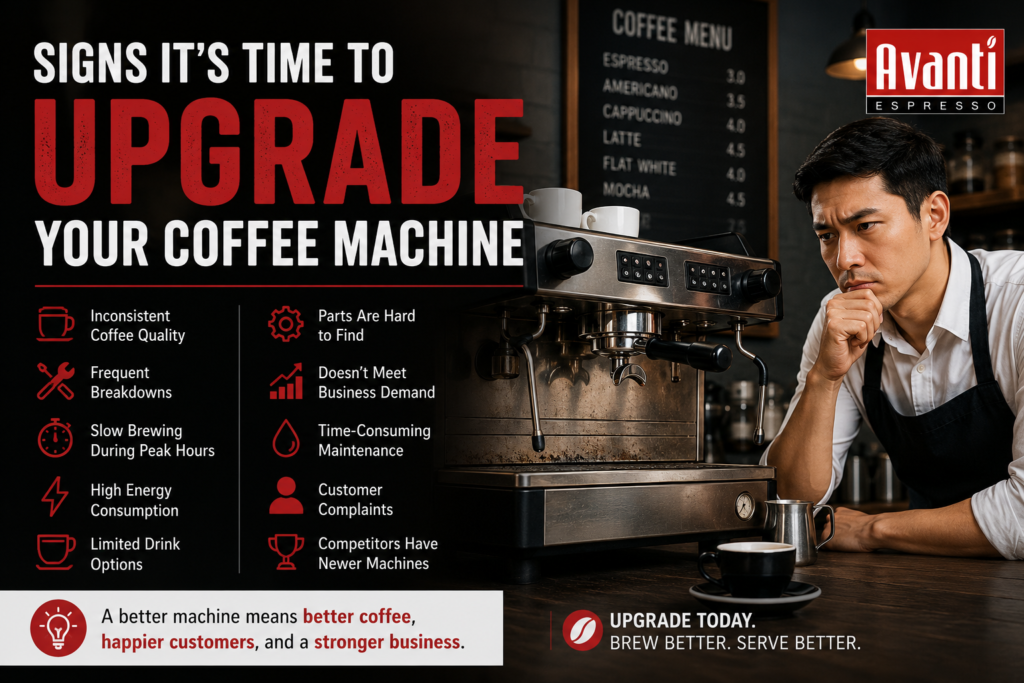
Every café and restaurant owner eventually asks the same question: is it time to upgrade coffee machine equipment, or is one more repair still worth it? The answer isn’t always obvious, because an ageing machine rarely fails all at once — it degrades slowly, one inconsistent shot and one small breakdown at a time, until the cost of keeping it running quietly exceeds the cost of replacing it.
This guide walks through the clearest signs that your commercial coffee machine has reached the end of its useful life, how to weigh repair against replacement, and what to look for in a modern machine before you invest — with practical guidance for cafés, restaurants, and hospitality businesses in Singapore.
In this article
- What Does It Mean to Upgrade a Commercial Coffee Machine?
- 8 Signs It’s Time to Upgrade Your Coffee Machine
- How an Outdated Coffee Machine Affects Your Business?
- Repair vs Upgrade: When Is Replacing the Better Investment?
- How Newer Coffee Machines Improve Workflow, Efficiency, and Consistency
- Features to Look For in a Modern Commercial Coffee Machine
- Tips for Choosing the Right Upgrade for Your Café or Restaurant
- Common Mistakes Businesses Make When Delaying an Upgrade
- Checklist: Is It Time to Upgrade Your Coffee Machine?
- Practical Recommendations for Cafés and Restaurants in Singapore
- 6. FAQ (People Also Ask)
What Does It Mean to Upgrade a Commercial Coffee Machine?
Upgrading a commercial coffee machine means replacing an ageing or underperforming unit with a newer model that offers better consistency, faster recovery times, improved energy efficiency, and features suited to current order volume — rather than continuing to repair a machine that can no longer keep pace with the business.
Featured-snippet definition: A coffee machine upgrade is the planned replacement of commercial brewing equipment once its performance, reliability, or running costs no longer meet a business’s operational needs, typically triggered by recurring faults, inconsistent output, or outdated technology rather than a single breakdown.
This is distinct from routine servicing or a one-off repair. An upgrade is a deliberate decision to replace the machine itself, usually made after a pattern of issues rather than a single incident.
8 Signs It’s Time to Upgrade Your Coffee Machine
The clearest signs that a coffee machine needs replacing are recurring faults, declining drink quality, and rising costs that don’t resolve after a repair. Any one of these signs on its own may just mean a service is due; several appearing together usually means the machine itself has reached its limit.
1. Inconsistent Shot Quality and Extraction
If the same grind, dose, and tamp pressure produce noticeably different shots from one pull to the next, worn internal components — such as a failing pump, degraded group head seals, or an unstable boiler — are often the cause, and no amount of barista adjustment will fully fix it.
2. Frequent Breakdowns and Rising Repair Bills
A machine that needs a technician more than once every few months is telling you that parts are failing faster than they can be replaced. Once repair costs across a year start approaching a third of what a new machine would cost, the maths generally favours replacement.
3. Slower Service During Peak Hours
Machines that take longer to reach temperature, recover slowly between shots, or require longer steam wait times create bottlenecks exactly when speed matters most, leading to longer queues and frustrated customers during your busiest periods.
4. Difficulty Finding Replacement Parts
Older or discontinued models eventually become harder to service as manufacturers stop stocking parts. When a technician starts quoting longer wait times for components, or sourcing parts from third parties, it’s a signal the machine is approaching the end of its supported life.
5. High Energy and Water Consumption
Older boilers and heating elements typically run less efficiently than current models, so a noticeable rise in utility costs without a change in usage patterns often points to an ageing, inefficient machine rather than a billing issue.
6. Outdated Technology and Lack of Programmability
Machines without programmable dosing, digital temperature control, or volumetric settings make it harder to maintain consistency across shifts and staff, and typically can’t support newer workflow features like pre-infusion (briefly wetting the coffee at low pressure before full extraction) or multi-boiler temperature stability.
7. Struggles to Keep Up with Growing Order Volume
A machine sized for a smaller menu or lower daily cup count will show its limits as volume grows — long queues, slow recovery, and inconsistent milk texturing are common signs the equipment has been outgrown by the business rather than simply worn out.
8. Visible Wear, Leaks, or Temperature Instability
Visible water leaks, pressure gauge fluctuations, or temperature swings during a shift are late-stage warning signs. By the time these are visible to staff, the underlying components have usually already been degrading for some time.
How an Outdated Coffee Machine Affects Your Business?
An outdated machine affects far more than the cup itself — it touches consistency, staff time, energy bills, and ultimately customer retention. Each of these costs is usually gradual, which is why many businesses underestimate how much an old machine is really costing them until they compare it against a replacement.
- Coffee quality: inconsistent extraction leads to variable taste, which customers notice even if they can’t articulate why
- Consistency: different baristas compensating for machine faults in different ways compounds the inconsistency
- Speed: slower recovery and longer heat-up times create bottlenecks during peak hours
- Maintenance costs: frequent repairs add up and often exceed the cost of a service contract on a newer machine
- Customer satisfaction: inconsistent drinks and longer wait times are among the most common reasons customers stop returning to a café
Repair vs Upgrade: When Is Replacing the Better Investment?
Repair is usually the better choice for an isolated fault on a machine under five years old. Upgrading becomes the better investment once repairs recur every few months, parts become difficult to source, or cumulative repair costs over a year or two approach what a replacement machine would cost.
Factor | Repair | Upgrade |
| Upfront cost | Lower per incident | Higher one-time cost |
| Long-term cost | Rises with recurring faults | Predictable, often lower over 2-3 years |
| Downtime risk | Recurs with each new fault | One-off installation downtime, then stable |
| Consistency | Temporary fix; issue often resurfaces | Resets performance to factory standard |
| Warranty & support | Limited to the specific repair | Full manufacturer warranty and support |
| Best for | Isolated faults on machines under 5 years old | Machines over 7 years old or with recurring issues |
As a general rule of thumb, if a machine has needed more than two significant repairs within 12 months, or is more than seven years old and showing several of the signs above, replacement is very likely to be the more cost-effective path over the following two to three years.
How Newer Coffee Machines Improve Workflow, Efficiency, and Consistency
Modern commercial coffee machines improve business operations through faster recovery times, programmable dosing that reduces reliance on individual barista technique, and more efficient boilers that lower water and energy consumption compared with older models.
Multi-boiler systems, such as those found in the FAEMA E71E BUTTONS A2, allow independent temperature control for brewing and steaming simultaneously, which keeps output consistent even during back-to-back milk-drink orders — something older single-boiler machines typically struggle to maintain under pressure.
Fully automatic machines have also advanced significantly, with programmable recipes that reduce training time for new staff and help maintain consistency across multiple locations or shift changes.
Features to Look For in a Modern Commercial Coffee Machine
The most valuable features in a modern commercial machine are multi-boiler temperature stability, programmable dosing, energy-saving standby modes, and diagnostic displays that flag maintenance needs before a full breakdown occurs.
- Independent boilers for brewing and steaming, so milk drinks don’t compromise shot temperature
- Programmable volumetric dosing for consistent output across different staff members
- Energy-saving or eco standby modes to reduce running costs during quiet periods
- Digital displays or diagnostics that flag maintenance needs early
- Compatibility with your existing grinder and workflow, or a bundled grinder upgrade
- Manufacturer support and local parts availability in Singapore
Tips for Choosing the Right Upgrade for Your Café or Restaurant
Choosing the right upgrade starts with matching machine capacity to actual daily cup volume, not aspirational growth projections, and weighing whether a traditional, fully automatic, or brewing/dispenser machine best fits your team’s skill level and menu.
Businesses unsure of the right capacity should first work out their daily cup count — a useful starting point is Avanti’s guide on choosing the right coffee machine size for your Singapore business, which breaks down machine categories by daily volume.
It’s also worth deciding early whether to buy or lease. Businesses preserving cash flow, or planning to scale quickly, often find renting an automatic coffee machine a more flexible route than an outright purchase, particularly during an upgrade cycle.
Common Mistakes Businesses Make When Delaying an Upgrade
The most common mistake is treating each breakdown as an isolated incident rather than tracking the cumulative cost and downtime across a year, which hides how much an ageing machine is really costing the business.
- Waiting for a complete failure instead of budgeting for a planned upgrade
- Underestimating the customer impact of slow service and inconsistent drinks
- Choosing a replacement based on price alone without matching capacity to actual volume
- Skipping staff training on new equipment, which limits the benefit of the upgrade
- Not accounting for energy savings when comparing the total cost of an old machine versus a new one
Checklist: Is It Time to Upgrade Your Coffee Machine?
- Machine is more than 7 years old
- Repairs have been needed more than twice in the past 12 months
- Shot quality varies noticeably even with consistent technique
- Service slows down during peak hours
- Replacement parts are difficult or slow to source
- Energy or water bills have risen without a change in usage
- Machine lacks programmable dosing or digital controls
- Order volume has grown beyond what the machine was designed for
Practical Recommendations for Cafés and Restaurants in Singapore
For most Singapore cafés and restaurants, the safest approach is to review machine performance annually against the checklist above rather than waiting for a breakdown to force the decision. Avanti Espresso, a Singapore coffee machine supplier operating since 1978, supplies and services commercial machines from brands including FAEMA, Casadio, and Bravilor, and can assess whether an existing machine is still cost-effective to maintain or ready for replacement.
Businesses that are still evaluating their first commercial machine, rather than replacing an existing one, may find Avanti’s guide to choosing reliable premium coffee machines in Singapore a more relevant starting point.
Explore Avanti’s full range of commercial coffee machines in Singapore to compare traditional, fully automatic, and brewing options suited to your upgrade.
6. FAQ (People Also Ask)
How often should a commercial coffee machine be replaced?
Most commercial espresso machines last 7-10 years with regular servicing, though high-volume cafés running the machine 10+ hours a day may need to consider replacement closer to the 5-7 year mark.
Is it cheaper to repair or replace a coffee machine?
Repair is usually cheaper for a single, isolated fault on a machine under 5 years old. Once repair costs start recurring every few months or approach 30-40% of a replacement machine’s price, upgrading typically works out cheaper over 2-3 years.
What are the signs an espresso machine needs servicing versus replacing?
A single issue, such as a worn gasket or a group head needing a rebuild, is usually a servicing matter. Recurring temperature instability, persistent leaks, or multiple failures within the same year point toward replacement rather than another repair.
How much does a commercial coffee machine upgrade cost in Singapore?
Commercial traditional espresso machines in Singapore typically range from roughly S$6,000 for compact models to over S$25,000 for multi-group, fully featured units, with leasing options available for businesses that prefer to spread the cost.
Should I buy or lease a new coffee machine?
Buying suits businesses with stable, predictable volume and available capital, while leasing suits newer or growing businesses that want to preserve cash flow and upgrade equipment more frequently without a large upfront outlay.
How long does a commercial espresso machine typically last?
With proper daily cleaning, descaling (removing mineral scale from the boiler and water lines), and professional servicing, a commercial espresso machine can run reliably for 7-10 years, though usage intensity, water quality, and maintenance consistency all affect actual lifespan.