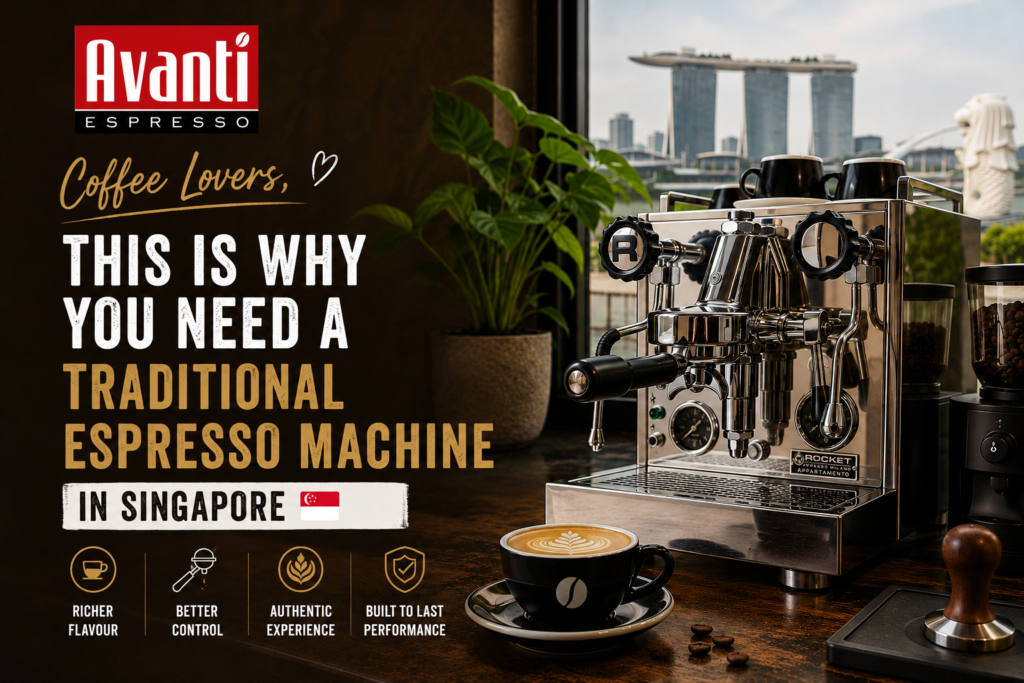
There is a moment every serious coffee drinker eventually hits. The capsule machine starts to feel like a compromise. The drip brewer produces something fine, technically, but flat. And somewhere between the third store-bought latte of the week and a quietly embarrassing café bill, the thought arrives: I should just learn to do this properly.
That thought usually leads to traditional espresso machines in Singapore — and for good reason. If you would rather not buy, espresso machine rental in Singapore is also available.
This guide is for the people who want more than convenience. It covers what traditional machines actually do, which Italian models are worth your money in 2026, and what you need to know before you buy coffee machines in Singapore.
Quick answer: A traditional espresso machine (a manual lever or semi-automatic machine where you grind, dose, tamp and time each shot yourself) suits cafés and enthusiasts who want direct control over extraction. In Singapore, Avanti Espresso carries FAEMA and Casadio traditional machines, from the single-group FAEMA E61 Jubilee A1 to dual-group models such as the E71E and President GTI, to buy or lease with local servicing.
In this article
- What Makes a Traditional Espresso Machine Different
- Why Singapore Is Actually a Good Place for This Hobby
- The Best Italian Traditional Espresso Machines in Singapore (2026)
- What to Sort Out Before You Buy a Commercial Espresso Machine
- Avanti Espresso: Singapore’s Trusted Source Since 1978
- Frequently Asked Questions
- The Bottom Line
- Sources
What Makes a Traditional Espresso Machine Different
Before anything else: what actually counts as a “traditional” machine?
The category covers two main types. Manual lever machines put pressure control entirely in your hands — you pull a lever to push hot water through the puck (the compacted bed of ground coffee in the portafilter). Semi-automatic machines automate the pump but leave grinding, dosing, tamping (pressing the ground coffee into a firm, level bed), and timing to you. Both sit apart from fully automatic and pod machines in a meaningful way: they require skill, and that skill directly shows up in the cup.
This is not a flaw. It is the point.
Coffee machines in Singapore that fall into the fully automatic camp will brew decent espresso. But decent and excellent are not the same thing, and the gap between them is where enthusiasts live. Traditional machines let you tune water temperature, extraction time, and pressure profiling (varying the brew pressure during a shot) to a specific bean’s character. You are not just pushing a button — you are brewing.
Why Singapore Is Actually a Good Place for This Hobby
A few things make Singapore a surprisingly comfortable environment for espresso enthusiasts.
First, the water. Singapore’s tap water is soft: PUB’s published drinking water quality data puts the average total hardness at about 43 mg/L as CaCO3 (PUB, Our Drinking Water Quality). That is good news for espresso equipment, because hard water causes scale build-up that damages boilers and group heads (the brewing unit the portafilter locks into) over time. Here, most machines only need a basic inline carbon filter to remove chlorine — not the heavy softening systems required in many other countries.
Second, the market has matured. You can now buy coffee machines in Singapore from reputable local dealers who carry Italian brands with local warranty support. This matters more than most buyers realise. A machine that costs S$1,500 to S$5,000 needs accessible servicing — not a six-week international shipping repair loop.
Third, the economics work. A well-pulled shot at home costs well under S$1. At current café prices in Singapore, a traditional machine pays for itself within a few months for daily drinkers.
The Best Italian Traditional Espresso Machines in Singapore (2026)
Italian brands dominate this category for a reason. The engineering heritage is real, and the build quality of even mid-range Italian machines tends to outlast budget alternatives from other markets. Here are the models worth considering.
FAEMA E98UP A2 — The Versatile Workhorse
The FAEMA E98UP A2 is the entry point into FAEMA’s professional range, and it earns its reputation through sheer reliability. Built for continuous use, it delivers consistent extraction across both groups, with stable temperature management that keeps performance steady through long service periods.
For buyers looking to step up from home-grade equipment into something built to commercial standards, the E98UP A2 is the honest first move. It is available to buy or lease through Avanti Espresso — a practical option for businesses that want to spread the investment.
FAEMA E61 Jubilee A1 — The Icon, Rebuilt
The E61 group head was a turning point for espresso when FAEMA introduced it in 1961. FAEMA describes it as the first machine to use a volumetric pump to give the water a constant 9-atmosphere pressure through the whole extraction, rather than relying on a lever (FAEMA, E61). The FAEMA E61 Jubilee A1 honours that history with a single-group machine that carries the same thermal stability and extraction consistency the E61 became known for, updated for modern use.
For smaller cafés, speciality coffee counters, or home setups where serious volume is not the priority, the E61 Jubilee A1 is a focused machine. It is not trying to do everything — it is trying to do one thing very well. Among the best Italian traditional espresso machines Singapore options available locally, it holds a distinct place for purists.
FAEMA E61 Jubilee A2 — Dual Group, Same DNA
The FAEMA E61 Jubilee A2 takes the same E61 heritage and scales it to two groups, making it suitable for cafés with higher throughput without sacrificing the character of the single-group version. The thermal dynamics stay consistent across both groups, and the build quality is unmistakably Italian.
For anyone comparing traditional espresso machines Singapore cafés actually run in production, the E61 Jubilee A2 shows up regularly. It is not the cheapest machine on the market — but it is one of the few where the brand history and the engineering genuinely align.
FAEMA Urban Series — For Modern Spaces
The FAEMA Urban Series is built for environments where aesthetics and function need to work together. Compact enough for counter-limited setups, it delivers FAEMA’s extraction quality in a design-conscious package that works as well in a boutique café as it does in a well-designed office.
If your space is part of the brand experience — and in Singapore’s competitive F&B landscape, it usually is — the Urban Series is worth a serious look. It sits at a mid-range price point among FAEMA’s lineup while maintaining the Italian engineering standards the brand is known for.
FAEMA Prestige A2 — The Step Up
The FAEMA Prestige A2 moves into higher-volume territory with dual-group capability, improved thermal stability, and a build spec designed for cafés that cannot afford inconsistent shots during a busy service. The name is not accidental — this is FAEMA positioning a machine for operators who have outgrown entry-level commercial gear.
For coffee businesses in Singapore that are scaling up or replacing an ageing machine, the Prestige A2 is the natural next step before moving into the flagship tier.
FAEMA E71E Buttons A2 and E71 Touch A2 — The Flagship Range
The FAEMA E71E Buttons A2 and FAEMA E71 Touch A2 are where FAEMA’s engineering reaches its highest expression for the Singapore market. Both are dual-group machines with advanced extraction systems, temperature precision, and the kind of build quality that commercial operations depend on at scale.
The distinction between the two comes down to interface: the E71E uses button controls, while the E71 Touch adds a touchscreen system for more granular management. Both sit at the top of the range available through Avanti Espresso, with lease options available for businesses that want flagship performance without the full upfront capital outlay.
FAEMA President GTI Buttons A2 — Heritage Performance
The FAEMA President GTI Buttons A2 carries one of FAEMA’s most storied names back into active production. Designed for high-demand environments, it combines heritage aesthetics with current extraction technology — a machine that reads as a statement piece while functioning as a production workhorse.
For cafés in Singapore that want coffee machines Singapore buyers notice, the President GTI is the rare machine that achieves that without sacrificing technical substance.
Casadio Nettuno A2 Compact — Serious Output, Smaller Footprint
The Casadio Nettuno A2 Compact is the practical answer for operations that need genuine espresso quality without the footprint or price tag of a larger commercial machine. Single-phase power compatibility makes installation more straightforward, and the compact body fits counter setups that larger machines cannot.
For Singapore cafés, pop-up operators, or any business where space is a real constraint, the Nettuno A2 Compact delivers without asking for a full commercial kitchen setup in return.
What to Sort Out Before You Buy a Commercial Espresso Machine
Work through these four checks before you commit:
- Pair the machine with an espresso-grade grinder.
- Confirm local servicing, spare parts and warranty support.
- Decide whether buying or leasing suits your budget.
- Check SAFETY Mark registration for household models.
Get the Grinder Right
A high-grade espresso machine paired with a mediocre grinder will not perform. Grind consistency directly affects extraction quality — uneven particle size causes channelling (water forcing its way through the weakest part of the coffee bed), producing flat or bitter espresso regardless of what the machine can do. Avanti Espresso also carries professional grinders — pairing a machine and grinder from the same source simplifies setup considerably.
Confirm Local Service Support
When you buy coffee machines in Singapore, local service availability is not a secondary consideration — it is essential. Avanti Espresso has maintained its FAEMA partnership for 34 years and handles technical support, spare parts, and warranty claims locally. That infrastructure is part of what you are buying.
Buy or Lease — Both Are Available
For businesses, the lease option available on every machine through Avanti Espresso makes high-end equipment accessible without full capital outlay upfront. For home buyers, the buy option is straightforward. Either way, the team can advise on which model fits the use case.
Check for Safety Mark Certification
Under Singapore’s Consumer Protection (Safety Requirements) Regulations, “coffee maker” is one of 33 categories of household Controlled Goods that must be tested, registered and carry the SAFETY Mark before sale (Consumer Product Safety Office, list of Controlled Goods). It is worth confirming the registration for any household machine you are considering.
Avanti Espresso: Singapore’s Trusted Source Since 1978
For Singaporean buyers, sourcing matters as much as product selection. Avanti Espresso has been in the market since 1978 — over four decades of supplying commercial and home espresso equipment to cafés, restaurants, and serious home users across Singapore.
Their range includes traditional espresso machines in Singapore from Italian manufacturers FAEMA and Casadio, alongside coffee beans and professional grinders. The team offers technical guidance, barista training, and after-sales service — not just a transaction.
If you are ready to move from browsing to buying, their traditional espresso machines category is the right starting point.
Frequently Asked Questions
What is the difference between a traditional espresso machine and a fully automatic machine?
A traditional machine (manual lever or semi-automatic) gives the user direct control over key variables like grinding, tamping, and extraction time. A fully automatic machine manages these steps internally. Traditional machines take more skill, and in return give the barista more control over the result.
Is Singapore’s water suitable for espresso machines?
Yes. Singapore tap water is soft (PUB reports an average total hardness of about 43 mg/L as CaCO3), which is good for espresso equipment. Most traditional machines here only need a basic inline carbon filter. You generally do not need a dedicated water softener.
Do I need to buy a separate grinder?
Yes. An espresso-grade standalone grinder is essential. Grind consistency affects extraction quality directly, and pre-ground coffee loses flavour compounds too quickly to produce good espresso.
Where can I buy coffee machines in Singapore with local warranty support?
Avanti Espresso has supplied coffee machines in Singapore since 1978 and supports the brands it carries locally. Always confirm local service availability before purchasing any machine.
Can I lease a traditional espresso machine in Singapore instead of buying?
Yes. Avanti Espresso offers lease options on all FAEMA and Casadio machines in its range. This is a practical option for businesses that want professional-grade equipment without full upfront capital expenditure.
The Bottom Line
Traditional espresso machines in Singapore are not for everyone. They require learning time, decent equipment pairing, and a genuine interest in the process. But for people who want café-quality espresso at home — and who would rather brew than just press a button — they are the right choice.
The Italian machines covered here are the traditional models Avanti Espresso carries in Singapore, across different budgets and skill levels. Whatever stage you are at, the path from daily café spend to home espresso mastery is shorter than most people expect.
Start with the right machine, a good grinder, and a reliable local supplier. The rest follows.
Sources
- PUB, Singapore’s National Water Agency: Our Drinking Water Quality (total hardness average 42.7 mg/L as CaCO3)
- FAEMA: E61 (volumetric pump, constant 9-atmosphere extraction pressure)
- Consumer Product Safety Office: List of Controlled Goods (coffee maker category)
Ready to explore your options? Browse Avanti Espresso’s full range of coffee machines in Singapore or visit espresso.com.sg to get in touch with their team.