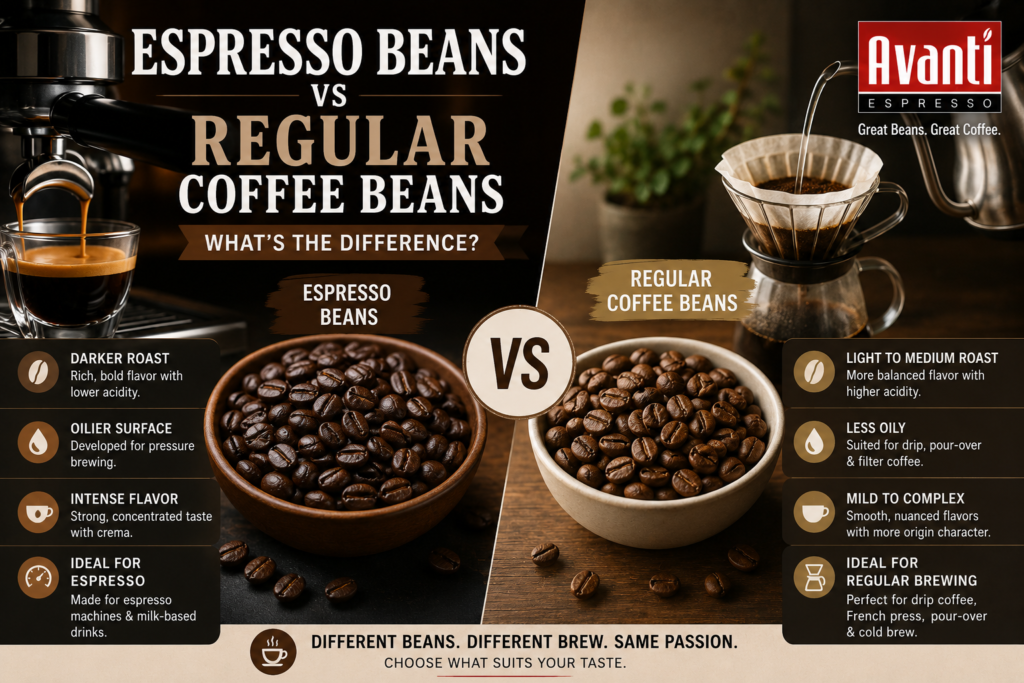
Espresso beans vs regular coffee beans is one of the most common questions café owners and home baristas ask, and the answer surprises most people: there is no separate “espresso bean” species. Avanti Espresso, a Singapore coffee bean supplier that has roasted for local cafés and restaurants since 1978, works with both espresso-specific blends and lighter filter roasts, and the difference between them comes down to how the bean is selected, roasted, and ground — not what it’s grown as. This guide breaks down exactly what changes between the two, and what a café, restaurant, or wholesale buyer should actually choose. If you are buying espresso beans in Singapore, the points below will help you choose.
In this article
- Are Espresso Beans Actually a Different Bean?
- Espresso Beans vs Regular Coffee Beans: Side-by-Side Comparison
- Common Myths About Espresso Beans
- Espresso Blends vs Single-Origin Beans: When Should a Business Choose Each?
- Practical Recommendations for Cafés and Restaurants Choosing Beans in Singapore
- 6. FAQ Section
Are Espresso Beans Actually a Different Bean?
No. Espresso beans are not a separate species or variety — they are ordinary coffee beans (Arabica, Robusta, or a blend of both) that have been roasted, blended, and ground specifically for espresso brewing. Any coffee bean can technically be pulled as an espresso shot; what changes is the roast profile and grind size, not the underlying bean.
Espresso is a brewing method — hot water forced through finely ground coffee at roughly 9 bars of pressure for 20 to 30 seconds — not a bean type. This aligns with the Specialty Coffee Association’s published coffee standards, which define espresso through machine and extraction specifications rather than bean characteristics. Green coffee only becomes “espresso beans” once a roaster picks a roast profile and blend designed to hold up under that pressure.
Espresso Beans vs Regular Coffee Beans: Side-by-Side Comparison
Espresso beans and regular coffee beans differ across eight practical factors: bean selection, roast level, flavour profile, grind size, brewing method, crema (the golden-brown foam on top of an espresso), caffeine per serving, and best use case. The table below compares a typical espresso blend against beans roasted for filter or drip brewing.
Factor | Espresso Beans | Regular Coffee Beans |
Bean selection | Arabica, Robusta, or a blend of both | Usually, 100% Arabica |
Roast level | Medium-dark to dark | Light to medium |
Flavour profile | Bold, chocolatey, nutty, low acidity | Bright, fruity, floral, higher acidity |
Grind size | Fine (like table salt) | Medium to coarse |
Brewing method | Espresso machine, 9 bars pressure | Drip, pour-over, French press, cold brew |
Crema | Present — golden-brown foam layer | Absent or minimal |
Caffeine per serving | ~60–75mg per 1oz shot | ~95–120mg per 8oz cup |
Best use case | Straight shots, milk-based drinks | Filter coffee, batch brew, pour-over |
Bean Selection: Arabica vs Robusta
Espresso blends frequently combine Arabica and Robusta because each contributes something different to the shot. Arabica generally carries lower caffeine content and more nuanced acidity, while Robusta is more caffeine-dense and produces thicker crema — figures the World Coffee Research Coffee Varieties Catalog documents in detail across cultivated varieties of both species. Avanti’s own Espresso Classico is a working example: a darker-roast blend that pairs Arabica for complexity with Robusta for intensity and crema. Regular coffee beans sold for filter brewing are more often 100% Arabica, since the brewing method doesn’t need Robusta’s body or crema.
Roast Level and Coffee Roasting for Espresso
Coffee roasting for espresso typically pushes into medium-dark or dark territory to reduce acidity, build body, and produce a flavour that holds up when diluted with milk. Filter and drip coffee is often roasted lighter to preserve origin-specific character — florals, fruit, citrus — that a longer, gentler brew method can extract without bitterness. Avanti’s Crema Oro, slow-roasted from high-altitude Colombian and Asian-origin beans, sits closer to that lighter, more approachable end, while Espresso Classico sits at the bolder, darker end built for straight shots.
Grind Size and Brewing Method
Espresso needs a fine grind because the brew time is short — 20 to 30 seconds — and a fine grind slows water flow enough to extract properly under pressure. Drip, pour-over, and French press methods use a coarser grind because water sits in contact with the grounds for several minutes; a fine grind in those methods over-extracts and turns bitter. Mismatched grind size is one of the most common reasons a “good” bean tastes wrong.
Crema: A Byproduct of Pressure, Not the Bean
Crema is the golden-brown foam on top of a shot, formed when CO2 and oils in the coffee emulsify under the high pressure unique to espresso extraction. It isn’t a marker of bean quality by itself — freshness matters more. Beans roasted more than a few weeks earlier have released most of their CO2 and will produce noticeably less crema regardless of roast level, which is why roast date matters as much as roast level for café-grade espresso.
Caffeine: The Common Misconception
Espresso has a higher caffeine concentration per ounce than drip coffee, but a standard drip serving usually contains more total caffeine than a single espresso shot because of serving size. A 1-ounce espresso shot carries roughly 60–75mg of caffeine, while an 8-ounce cup of brewed coffee typically contains 95–120mg, according to figures the National Coffee Association publishes on caffeine content. Espresso feels stronger because it’s consumed quickly and concentrated, not because it delivers more caffeine per cup.
Common Myths About Espresso Beans
The most common myths are that espresso beans come from a different plant, that espresso must always be dark-roasted, and that espresso always contains more caffeine than drip coffee. None of these hold up against how beans are actually grown, roasted, and extracted.
- Myth: Espresso beans come from a different coffee plant. They don’t — see the section above. Any coffee bean can be roasted and ground for espresso.
- Myth: Espresso has to be dark-roasted. Most commercial espresso is medium-dark to dark, but some specialty roasters produce lighter single-origin espresso to highlight origin character, accepting a brighter, more acidic shot.
- Myth: Espresso is always higher in caffeine than regular coffee. As shown above, a full drip serving typically edges out a single shot in total caffeine, even though espresso is more concentrated per ounce.
- Myth: Oilier beans are always better for espresso. Bean oil sheen mostly reflects roast level and freshness, not brewing suitability — an overly oily, stale bean can taste flat regardless of roast.
Espresso Blends vs Single-Origin Beans: When Should a Business Choose Each?
Espresso blends suit most commercial café and restaurant service because they’re built for consistency, crema, and balance shot after shot, across different baristas and machine settings. Single-origin espresso suits specialty-focused cafés that want to showcase a distinct origin character and have the barista skill to dial in a less forgiving bean.
Blends make sense when a business needs predictable output at volume, wants cost flexibility if one origin’s price spikes, and has staff turnover that makes a forgiving, consistent bean valuable. Single-origin espresso makes sense for specialty-positioned cafés with a stable, experienced barista team, where highlighting one farm or region’s flavour is part of the brand story — accepting that dialing-in takes longer and results vary more between staff.
Practical Recommendations for Cafés and Restaurants Choosing Beans in Singapore
Singapore cafés and restaurants should match bean choice to service volume, machine type, and customer base: high-volume commercial service is generally better served by a consistent espresso blend, imported beans need protection from Singapore’s heat and humidity, and locally roasted beans shorten the gap between roast date and cup.
Singapore’s climate accelerates staling — heat and humidity degrade unroasted and roasted beans faster than in temperate markets, so airtight storage and smaller, more frequent orders matter more here than in cooler climates. Buying from a supplier that roasts locally also shortens freight time and keeps beans fresher on arrival. On flavour, local palates shaped by decades of Nanyang kopi culture often lean toward strong, heavy-bodied, Robusta-influenced blends, while a growing specialty-focused customer base increasingly wants lighter, Arabica-forward single-origin options — which is why many Singapore cafés stock more than one bean profile rather than a single house blend. For businesses running traditional espresso machines, a supplier who understands both the beans and the machine side of extraction is worth more than one who only sells bags.
If you’re sourcing for a café, restaurant, or wholesale account, browse Avanti Espresso’s coffee bean range or check the wholesale programme for bulk pricing and supply support.
6. FAQ Section
Are espresso beans and regular coffee beans really different?
No — both come from the same coffee plant species (Arabica, Robusta, or a blend). The difference is in roast level, grind size, and how the bean is blended for the brewing method it’s intended for.
Can I use regular coffee beans to make espresso?
Yes, technically. The shot will likely taste brighter and more acidic than one made with a dedicated espresso roast, since lighter roasts weren’t developed to hold up under high-pressure extraction.
What roast level is best for espresso beans?
Most commercial espresso uses a medium-dark to dark roast because it lowers acidity and builds body. Some specialty roasters use lighter roasts for single-origin espresso to highlight specific origin flavours.
Does espresso have more caffeine than regular coffee?
Per ounce, yes — but per serving, no. A standard 8-ounce cup of drip coffee typically contains more total caffeine than a single 1-ounce espresso shot, because serving size matters more than concentration.
Should my café use an espresso blend or single-origin beans?
Most commercial cafés and restaurants get more consistent results from an espresso blend, since it’s designed for stability across baristas and machines. Single-origin espresso works best for specialty-focused venues with experienced staff.
Why does espresso have crema and regular coffee doesn’t?
Crema forms when CO2 and natural oils in the coffee emulsify under the roughly 9 bars of pressure used in espresso extraction. Drip and pour-over methods don’t use that pressure, so they don’t produce crema.