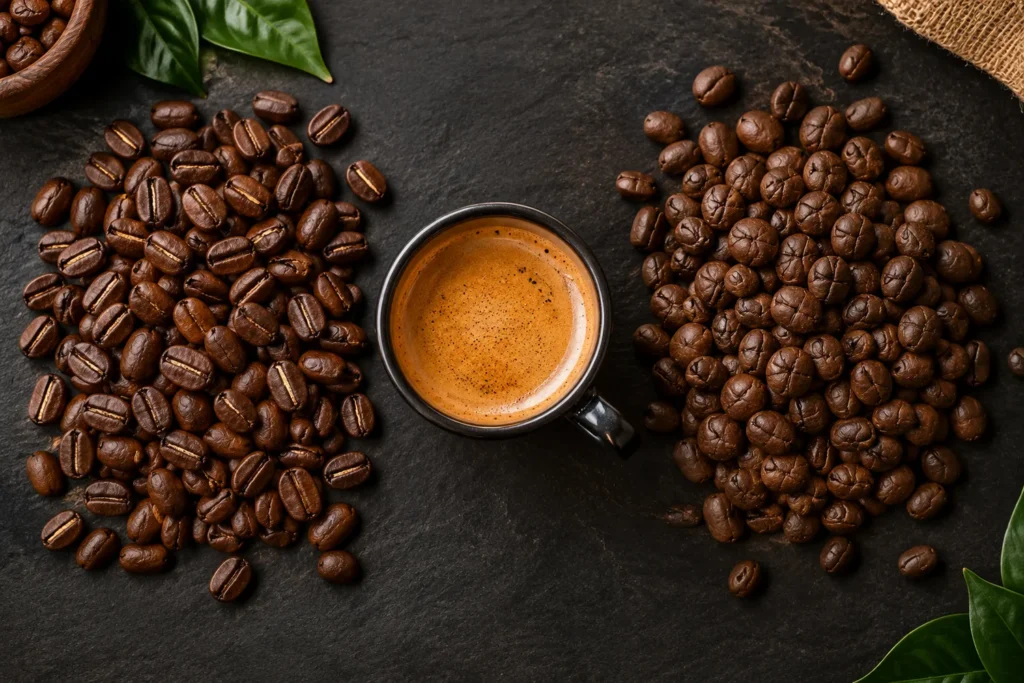
Arabica vs Robusta comes down to two different coffee plants with different strengths. Arabica grows in cooler highlands and is valued for cup quality, while Robusta grows in hot lowlands, and its brews carry about twice the caffeine. For a busy café, the right choice depends on your menu, your customers and the strength they expect. An Arabica and Robusta blend suits a strong, milk-led menu, while 100% Arabica suits a softer, sweeter cup.
Key takeaways
- Arabica’s optimum mean annual temperature is 18 to 21°C; Robusta’s is 22 to 26°C (Brazilian Journal of Plant Physiology).
- Robusta brews contain about twice the caffeine of Arabica brews (Food Biophysics).
- Robusta was estimated at 43.1% of world coffee production in coffee year 2025/26 (ICO).
- Research does not show that Robusta is essential for crema; the role of species in espresso foam “is not established” (Food Biophysics).
- Dolce Oro is 100% Arabica, and Espresso Classico blends Arabica with Robusta (Avanti Espresso).
In this article
- What is the difference between Arabica and Robusta?
- How do caffeine, taste and crema compare?
- How much of the world’s coffee is Arabica and how much is Robusta?
- Why do many espresso blends include some Robusta?
- Which coffee blend is better for a busy café?
- Worked example: matching a café menu to a blend
- How do Avanti’s blends compare?
- Is a Robusta blend right for your café?
- Common mistakes
- Further reading
- Frequently Asked Questions
- Sources
What is the difference between Arabica and Robusta?
Arabica and Robusta are two separate species. Arabica is Coffea arabica. Robusta is the common name for Coffea canephora. Together, these two species are responsible for about 99% of world bean production, according to a review in the Brazilian Journal of Plant Physiology.
They come from very different places. Wild Arabica is restricted to the highland forests of southwestern Ethiopia, at 1,600 to 2,800 metres. Many forms of Robusta grow wild in the equatorial lowland forests from Guinea to Uganda (Brazilian Journal of Plant Physiology).
That origin still shapes how each is farmed. CIRAD, the French agricultural research centre, says Arabica likes cool climates without frost and prefers mountain ecologies. Robusta prefers low altitudes and hot, humid equatorial climates. The Brazilian Journal of Plant Physiology review gives Arabica an optimum annual rainfall of 1,200 to 1,800 mm. Robusta adapts better to heavy rainfall above 2,000 mm.
CIRAD also notes that Arabica is self-fertilising and grown from seed, while Robusta is traditionally grown from cuttings. It describes Robusta as more vigorous, more disease resistant and higher yielding.
How do caffeine, taste and crema compare?
Caffeine. CIRAD puts Arabica at around 1.5% caffeine and Robusta at 1.6% to 2.8%. A review in the journal Food Biophysics found caffeine about twice as high in Robusta brews as in Arabica brews.
Taste. CIRAD says Arabica has traditionally been seen as better quality, and describes Robusta as having “a more ordinary taste”. The Brazilian Journal of Plant Physiology review says Arabica’s beverage quality is superior. The Food Biophysics review adds that the aroma profiles and chemical make-up of the two brews are different.
Crema. The Food Biophysics review found no significant difference in foam volume between pure Arabica and pure Robusta espresso. The look differs, as Table 1 shows. In one study, crema lasted longer for Robusta than for Arabica at a medium roast.
Table 1: Arabica vs Robusta at a glance
| Feature | Arabica (Coffea arabica) | Robusta (Coffea canephora) | Source |
| Wild origin | Highland forests of southwestern Ethiopia | Equatorial lowland forests, Guinea to Uganda | Brazilian Journal of Plant Physiology |
| Optimum mean annual temperature | 18 to 21°C | 22 to 26°C | Brazilian Journal of Plant Physiology |
| Preferred terrain | Cool, frost-free mountain areas | Low altitude, hot and humid | CIRAD |
| Caffeine in the bean | Around 1.5% | 1.6% to 2.8% | CIRAD |
| Caffeine in the brew | Baseline | About twice as high | Food Biophysics |
| Crema colour | Reddish-brown, “tiger skin” | Dark brown with grey tones | Food Biophysics |
| Crema bubbles | Smaller | Larger | Food Biophysics |
| Taste reputation | Traditionally seen as better quality | “A more ordinary taste” | CIRAD |
| World production, 2026/27 forecast | 105.9 million bags | 83.8 million bags | USDA |
How much of the world’s coffee is Arabica and how much is Robusta?
Arabica is still the larger crop, but the gap is narrowing. The USDA Foreign Agricultural Service forecasts world production of 189.7 million 60 kg bags for 2026/27. Of that, 105.9 million bags are Arabica and 83.8 million are Robusta.
The International Coffee Organization estimates Robusta’s share of world production at 43.1% in coffee year 2025/26. That is up from an average of 41.7% over the two previous coffee years.
Brazil and Vietnam lead the two crops. The USDA forecasts Brazil’s 2026/27 Arabica crop at 47.5 million bags. Vietnam’s Robusta crop is forecast at 31.4 million bags, the largest in the world.
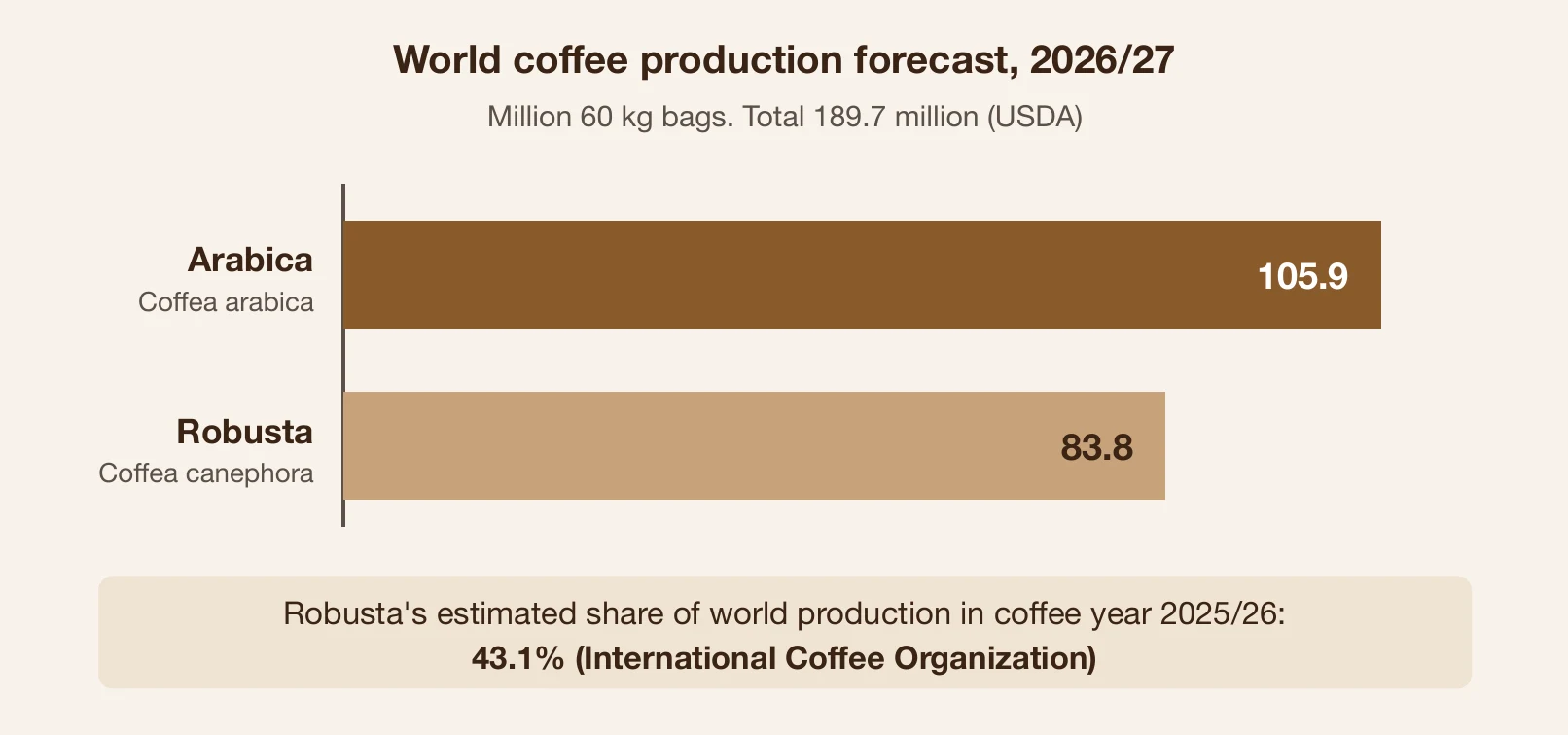
Figure 1: World coffee production forecast for 2026/27 by species, in million 60 kg bags (USDA), with Robusta’s estimated 2025/26 share (ICO).
Why do many espresso blends include some Robusta?
The reason most often given is crema. The Food Biophysics review notes that Robusta has been claimed to be “indispensable to confer a proper crema to an Italian espresso”. The same review says this claim has been “substantially contradicted by recent experimental data”. It concludes that carbon dioxide and lipid content seem to matter more than species.
According to the sources, Robusta adds three things:
- Strength. Robusta brews carry about twice the caffeine of Arabica brews (Food Biophysics).
- A different crema look. Robusta crema is darker, with larger bubbles, and lasted longer in one dataset (Food Biophysics).
- A different flavour. The aroma and chemistry of the two brews differ (Food Biophysics), and CIRAD describes Robusta’s taste as more ordinary.
Avanti’s own description of Espresso Classico follows the same logic. It pairs premium Arabica for smooth complexity with Robusta for intensity, rich crema and lasting flavour. In short, Robusta is a choice about strength and style. It is not a rule for good espresso.
Which coffee blend is better for a busy café?
There is no single best coffee blend for espresso. Ask which blend suits your menu and your regulars, using these four points.
1. Milk drinks or black coffee? Count how many drinks contain milk. Milk changes how the espresso tastes, so a stronger blend can help in milk drinks. If most orders are espressos and long blacks, the bean’s own taste is on show.
2. What do your customers expect? Some want a bold, strong cup. Others want sweetness and a softer finish. Listen to repeat orders, not only staff preference.
3. Can you serve the same cup all day? A busy café needs one house blend that every barista can dial in and repeat. Avanti, for example, roasts Crema Oro in controlled small batches for uniform flavour, aroma and crema.
4. Are you following an Italian-style tradition? The Food Biophysics review records an earlier claim that Italian espresso needs Robusta. If your menu is built around short, strong Italian-style drinks, an Arabica and Robusta blend fits that style.
Table 2: Matching your menu to a blend type
| Your menu and customers | What to prioritise | Blend type to test first |
| Mostly lattes, cappuccinos and flat whites | Coffee flavour that still shows through milk | Arabica and Robusta blend |
| Mostly espresso and long blacks | Sweetness and aroma when served black | 100% Arabica |
| Regulars who ask for a strong, bold cup | Strength and body | Arabica and Robusta blend, darker roast |
| Customers who prefer a sweet, gentle cup | Smoothness and low bitterness | 100% Arabica |
| Large batches of brewed coffee for events | Volume and holding for service | A blend made for brewing |
| Customers who avoid caffeine | A decaf option | Decaf alongside the house blend |
Worked example: matching a café menu to a blend
This example is illustrative, not from a real café. It shows how to turn a sales mix into a blend decision.
A neighbourhood café serves 180 coffees a day with two baristas on each shift. Its sales records show this mix:
- 120 milk drinks (lattes, cappuccinos, flat whites): two thirds of all coffees.
- 45 black drinks (espresso and long black): one quarter.
- 15 decaf drinks: one in twelve.
Step 1: pick the house blend for the biggest group. Milk drinks are two thirds of sales. The owner shortlists Espresso Classico for strength through milk. For comparison, she adds Dolce Oro, which Avanti describes as suited to lattes and cappuccinos.
Step 2: check the black-coffee group. The 45 black drinks come mostly from morning regulars who like a strong cup. Classico’s dark chocolate and nutty notes may suit them. If they preferred a sweeter shot, Dolce Oro would point the other way.
Step 3: cover decaf separately. At 15 drinks a day, decaf is worth keeping. The café stocks Gourmet Decaf in its own hopper or as ground coffee.
Step 4: taste before deciding. The team tastes both shortlisted blends as espresso and as a latte, side by side. Avanti’s wholesale coffee bean supply page invites businesses to book a showroom appointment to taste the blends.
The result is one house blend for 165 of 180 daily coffees, plus a decaf. Two baristas learn one recipe well.
How do Avanti’s blends compare?
Here is an espresso blend comparison of the Avanti range, using only what each product page states.
Table 3: Avanti coffee beans, as described on espresso.com.sg
| Avanti blend | Species stated | What the page says | Uses the page mentions |
| Dolce Oro | 100% Arabica | Medium body, slow roasted, notes of honey, caramel and soft florals | Espresso, lattes and cappuccinos |
| Espresso Classico | Arabica and Robusta | Darker roast, strong nutty aroma, dark chocolate, subtle smokiness | Straight espresso and milk-based drinks |
| Crema Oro | Not stated; beans from Medellín, Colombia and select Asian origins | Golden crema, caramel, toasted nuts, floral hints; smooth and lightly roasted | Straight espresso, cappuccinos and lattes |
| Caffe Natura | Not stated | 100% organic, Fair Trade certified, floral and fruity notes, mild cacao finish | A morning ritual or an afternoon break |
Crema Oro and Caffe Natura are both roasted locally in Singapore, according to their product pages. You can see every blend in the full Avanti coffee bean range.
Is a Robusta blend right for your café?
A blend with Robusta suits you if most drinks contain milk and your customers like a strong cup. It also suits an Italian-style menu of short, intense drinks.
It may not suit you if your customers drink mostly black coffee and want sweetness. In that case, 100% Arabica such as Dolce Oro is a sensible first test.
Keep these limits in mind:
- Species is only one factor. The Food Biophysics review found carbon dioxide and lipids mattered more than species for foam.
- Flavour notes on product pages describe taste, not laboratory results.
- Your machine, grinder and barista skill all change the cup.
Common mistakes
- Choosing by label alone. “100% Arabica” does not guarantee the best result for a milk-heavy menu. Taste it in the drinks you sell.
- Adding Robusta only for crema. Research does not support Robusta as essential for crema. Choose it for strength and style.
- Ignoring caffeine. Robusta brews carry about twice the caffeine. Tell customers if your house blend is strong.
- Skipping staff practice. A new blend needs a new recipe. Give staff time to practise it before service.
Further reading
- The best coffee beans for each espresso-based drink, from shots to mochas.
- How espresso beans differ from regular coffee beans, including roast and grind.
- Our FAEMA espresso machine guide, for matching a machine and grinder to your blend and volume.
Choosing espresso beans Singapore cafés can rely on is easier when you can taste the options side by side. Avanti Espresso has supported Singapore’s cafés since 1978, and roasts its blends locally once or twice a week. Bring your menu and your sales mix, and we will help you shortlist a house blend and a decaf. Talk to our team
Frequently Asked Questions
Is Arabica better than Robusta for espresso?
Not always. Arabica is traditionally seen as better quality, according to CIRAD. Robusta brings about twice the caffeine and a darker crema. A blend of the two can keep espresso strong through milk. The better choice depends on your menu and what your customers like to drink.
Does Robusta have more caffeine than Arabica?
Yes. CIRAD puts Arabica at around 1.5% caffeine and Robusta at 1.6% to 2.8%. A review in Food Biophysics found Robusta brews held about twice the caffeine of Arabica brews. A blend with Robusta will usually taste stronger, so tell customers if your house blend is a strong one.
Do you need Robusta to get good crema?
No. Robusta has been claimed to be essential for crema in Italian espresso. A review in Food Biophysics says recent experimental data substantially contradicts this. Robusta crema looks darker, with larger bubbles. The review found carbon dioxide and lipid content seem to matter more than species. So a fresh, well-extracted Arabica can still give good crema.
Which Avanti blend is 100% Arabica?
Dolce Oro is the Avanti blend described as 100% Arabica. Its product page lists a silky medium body with notes of honey, caramel and soft florals. Avanti suggests it for espresso, lattes and cappuccinos. If you want Robusta in the cup for extra strength, Espresso Classico blends Arabica with Robusta in a darker roast.
What is the best coffee blend for espresso in a busy café?
The best blend is the one that matches your sales mix and that your baristas can repeat all day. If most orders contain milk, test an Arabica and Robusta blend first. If most are black, test 100% Arabica. Taste both as espresso and as a latte before you commit to a house blend.
Can a café use two different blends?
Yes, but keep it simple. Each blend usually needs its own grinder and recipe, which adds work during a rush. One house blend plus a decaf keeps service simple. A second espresso blend makes sense only when enough customers order it to keep the beans fresh and the grinder busy.