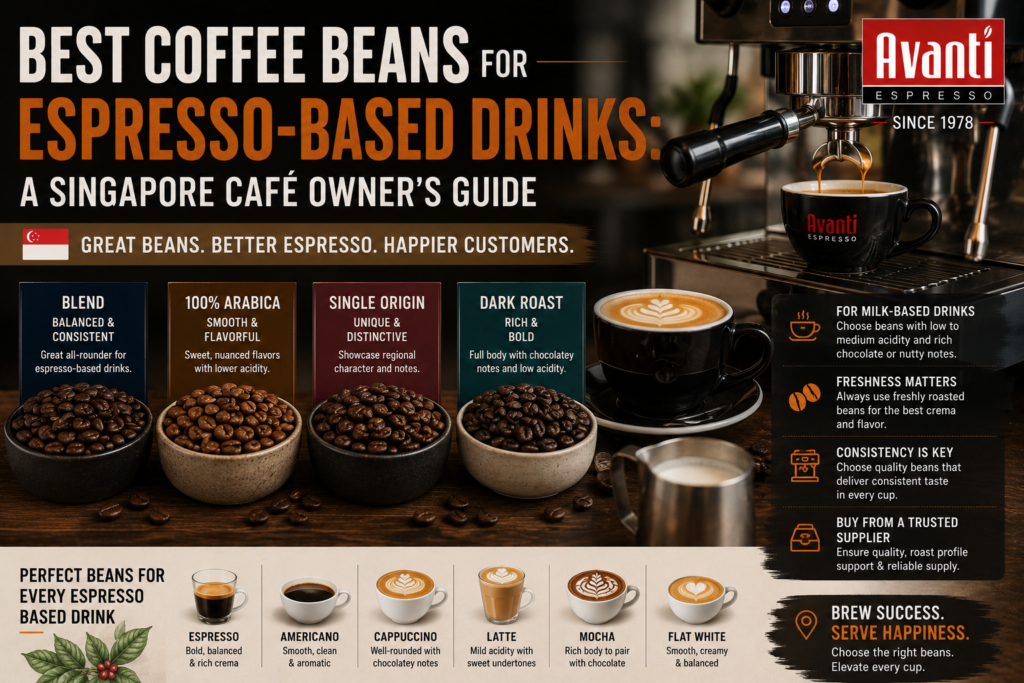
Choosing the best coffee beans for espresso is the single decision that shapes every drink on your menu — from a straight shot to a six-hour cappuccino run. Get the bean wrong and no amount of machine calibration, milk texturing, or barista skill can fully compensate. Get it right, and consistency, crema (the golden-brown foam on top of an espresso), and customer loyalty follow. Great espresso coffee in Singapore starts with beans roasted for espresso and stored well in the local humidity.
This guide breaks down what actually makes a bean espresso-ready, how Arabica and Robusta behave differently under pressure, and which beans work best across shots, lattes, cappuccinos, flat whites, mochas, and long blacks — with practical guidance for cafés and restaurants sourcing coffee beans Singapore operators can rely on day to day.
In this article
- What Makes a Coffee Bean Suitable for Espresso?
- Arabica vs Robusta for Espresso: Which Performs Better?
- Single-Origin vs Espresso Blends: What Should Cafés Use?
- Light, Medium, and Dark Roast: How Do They Compare for Espresso?
- Best Coffee Beans for Every Espresso-Based Drink
- How Cafés Choose Espresso Beans
- How Roast Level Affects Crema, Sweetness, Acidity, and Body
- Choosing Beans Based on Your Espresso Machine Type
- Storage and Freshness Tips for Espresso Beans
- Common Mistakes When Selecting Espresso Beans
- Buyer’s Checklist: Choosing Espresso Beans for Your Café
- Practical Recommendations for Cafés and Restaurants in Singapore
- 6. FAQ (People Also Ask)
What Makes a Coffee Bean Suitable for Espresso?
A bean is espresso-suitable when it can withstand high-pressure extraction (around 9 bars; FAEMA describes 9 atmospheres as the ideal brewing pressure for its pump-driven E61, see FAEMA E61) and still produce balanced sweetness, body, and crema rather than sharp acidity or hollow bitterness. This depends on freshness, roast level, density, and oil content — not on any single origin or species being universally “the best.”
Featured-snippet definition: Espresso is a concentrated coffee brewing method that forces hot water through finely ground, tightly packed coffee at roughly 9 bars of pressure, extracting oils and compounds that produce a thick body and a layer of crema on top.
Beans destined for espresso are usually roasted slightly darker than filter coffee, ground much finer, and dosed more densely. Freshness is critical: beans that are too fresh (under 4–5 days off roast) can produce uneven crema, while beans past their peak lose aromatic oils and taste flat. Most specialty roasters recommend using espresso beans within 2–4 weeks of the roast date for peak performance.
Arabica vs Robusta for Espresso: Which Performs Better?
Arabica delivers smoother acidity, more complex sweetness, and lower caffeine, while Robusta delivers roughly double the caffeine, a heavier body, and thicker crema. Neither is objectively superior — most commercial espresso blends combine both, using Robusta in smaller ratios to boost crema and body without overwhelming Arabica’s flavour clarity.
Coffea arabica typically grows at higher altitudes and accounts for the majority of specialty-grade coffee, while Coffea canephora (Robusta) is hardier, higher-yielding, and traditionally used in commercial and Italian-style espresso blends for its strength and crema. The Specialty Coffee Association uses a 100-point cupping scale, with beans scoring 80 or above classified as specialty grade — a benchmark increasingly applied to high-quality Robusta as well as Arabica.
For cafés serving Singapore’s mixed coffee culture — where speciality drinkers and traditional strong-coffee drinkers often order side by side — a blend that layers Arabica’s clarity over a controlled percentage of Robusta tends to perform more consistently across a full menu than either species alone.
Single-Origin vs Espresso Blends: What Should Cafés Use?
Single-origin beans highlight one farm or region’s distinct flavour notes and suit cafés wanting to showcase terroir, but they can be inconsistent across harvests. Espresso blends combine multiple origins (and sometimes species) to balance acidity, body, sweetness, and crema, giving cafés a repeatable flavour profile shot after shot, day after day.
For high-volume commercial service, blends are the safer choice because roasters can adjust the recipe to maintain a consistent cup even as green coffee availability shifts seasonally. Single-origin espresso works well as a rotating “guest” offering for cafés that want to differentiate their menu, but it’s rarely the right foundation for a house blend used across lattes, cappuccinos, and long blacks all day.
Avanti Espresso’s own range reflects this split: Crema Oro is a smooth, lighter-roast blend built for approachable milk drinks, Espresso Classico is a rich, intense dark-roast blend for drinkers who prefer traditional strength, and Caffe Natura is a 100% Fair Trade Organic option for sustainability-conscious menus.
Light, Medium, and Dark Roast: How Do They Compare for Espresso?
Light roasts preserve the most origin acidity and delicate florals but can taste sour or thin under high-pressure extraction if not dialled in carefully. Medium roasts strike the most reliable balance of sweetness, body, and crema for espresso. Dark roasts maximise body and bittersweet, chocolatey notes but sacrifice nuanced acidity and can taste ashy if pushed too far.
Roast Level | Acidity | Body | Crema | Best For |
Light | High | Light | Thinner, lighter-coloured | Single-origin espresso, filter-style shots |
Medium | Balanced | Medium-full | Rich, stable | Lattes, cappuccinos, flat whites, all-day café use |
Dark | Low | Heaviest | Thick but can be flat | Long black, mocha, traditional strong-coffee drinkers |
Most commercial café blends in Singapore, including Avanti’s Crema Oro and Espresso Classico, sit in the medium-to-dark range because that profile holds up best under milk and matches local flavour preferences shaped by decades of strong, chocolatey Kopi-O-style coffee.
Best Coffee Beans for Every Espresso-Based Drink
Different drinks demand different roast and blend characteristics because milk ratio, dilution, and serving temperature change how the bean’s flavour comes through. Matching bean to drink — rather than using one bean for the entire menu — is how experienced cafés keep every item tasting intentional rather than accidental.
Espresso Shots
Medium-roast blends with balanced acidity and sweetness perform best neat, since there’s no milk to soften harsh notes. A blend like Crema Oro, built for smoothness, shows well here.
Coffee Beans for Latte
Because milk dominates the cup, a fuller-bodied, slightly darker medium roast cuts through better than a delicate light roast, which tends to disappear. Espresso Classico’s intensity holds its own against steamed milk.
Coffee Beans for Cappuccino
Cappuccino’s higher foam-to-milk ratio needs a bean with enough acidity and sweetness to stay noticeable through the foam — a balanced medium roast with good crema retention works best.
Coffee Beans for Flat White
With less milk and a tighter microfoam than a latte, flat whites showcase the bean more directly, making a well-balanced, slightly brighter medium roast — including quality single-origin Arabica — a strong choice.
Mocha
Chocolate and coffee compete for attention, so a darker, bolder roast with chocolatey or nutty undertones (like Espresso Classico) complements the added cocoa rather than getting lost.
Long Black
Since espresso is diluted with hot water rather than milk, the bean’s true character is fully exposed — a clean, well-roasted medium blend avoids the harshness that dark, over-extracted beans can show when stretched with water.
How Cafés Choose Espresso Beans
Cafés typically evaluate beans on four factors: flavour consistency across batches, crema performance on their specific machine, freshness and roast-to-delivery lead time, and price stability from a supplier who can guarantee supply. Taste alone isn’t enough — a bean that cups beautifully but performs inconsistently under commercial volume creates more problems than it solves.
Reliable sourcing matters as much as the bean itself. Many Singapore cafés have found that switching to a dedicated wholesale coffee bean supplier — rather than sourcing ad hoc — is what stabilises quality across hundreds of daily cups.
How Roast Level Affects Crema, Sweetness, Acidity, and Body
Roast level directly determines how much sugar caramelises, how much acidity survives, and how much oil migrates to the bean’s surface — all of which shape crema thickness, sweetness, and mouthfeel in the final shot. Lighter roasts retain more acids and produce thinner crema; darker roasts caramelise more sugars, build heavier body, and produce thicker (though less stable) crema.
As roasting progresses, chlorogenic acids break down and Maillard reaction byproducts increase, which is why darker roasts taste rounder and less bright but also lose some of the origin-specific complexity found in lighter profiles. This is a chemistry trade-off, not a quality judgement — the “correct” roast level depends entirely on the drink and the drinker.
Choosing Beans Based on Your Espresso Machine Type
Traditional lever and semi-automatic machines give baristas full control over extraction, so they can handle a wider range of roast levels, including lighter, more acidic profiles. Fully automatic and super-automatic machines, which grind and tamp with fixed parameters, generally perform more consistently with medium-to-dark roasts that are more forgiving of less precise extraction.
Café owners investing in traditional espresso machines have more flexibility to experiment with single-origin (coffee from one country, region or farm) or lighter-roast beans, since a skilled barista can adjust grind and pressure in real time. Businesses running high-volume, lower-touch service tend to get better consistency pairing fully automatic machines with a stable, medium-roast commercial blend.
Storage and Freshness Tips for Espresso Beans
Espresso beans should be stored in an airtight container, away from heat, light, and moisture, and used within 2–4 weeks of the roast date for best crema and flavour. Whole beans should only be ground immediately before extraction, since ground coffee loses aromatic compounds within minutes of exposure to air.
For cafés, this means ordering in quantities matched to actual weekly turnover rather than bulk-buying for cost savings alone — a slightly higher per-kilo price on fresher, more frequent deliveries almost always outperforms cheaper beans that have sat in storage too long.
Common Mistakes When Selecting Espresso Beans
The most common mistake is choosing beans based on origin story or price alone rather than how they actually perform under a café’s specific machine, grinder, and volume. Other frequent errors include buying beans too far in advance of use, ignoring roast date on packaging, and failing to re-test a blend after switching grinders or machines, which can shift extraction significantly even with the same beans.
Cafés also sometimes select a bean because it tastes excellent as a single shot, without testing how it performs across the full milk-drink menu — a mistake that shows up quickly in customer feedback on lattes and cappuccinos.
Buyer’s Checklist: Choosing Espresso Beans for Your Café
- Roast date is visible and within the last 2–4 weeks
- Roast level matches your primary drink mix (medium for milk drinks, lighter for single-origin espresso)
- Blend or bean has been tested on your actual machine and grinder, not just cupped
- Supplier can guarantee consistent supply and pricing at your volume
- Crema performance holds up after 20–30 seconds, not just at pour
- Supplier offers barista training or technical support if your team is new to the blend
- Packaging includes proper one-way valve bags to preserve freshness in transit
Practical Recommendations for Cafés and Restaurants in Singapore
Given Singapore’s mixed coffee culture — where speciality drinkers and traditional strong-coffee drinkers often order from the same menu — most commercial cafés do best with a core medium-to-dark espresso blend for daily service, supplemented by a lighter single-origin option for flat whites or filter-style specials. Avanti Espresso, a Singapore coffee bean supplier operating since 1978, roasts its blends locally and supplies cafés, restaurants, and hotels across the island, which shortens the gap between roast date and delivery — a factor that matters more for crema and freshness than most buyers realise.
Businesses evaluating suppliers should also weigh technical support: a supplier with genuine espresso machine expertise can help diagnose whether an inconsistent shot is a bean issue, a grind issue, or a machine issue — something a purely transactional bean vendor usually can’t do.
Explore Avanti’s full range of coffee beans in Singapore to find a blend suited to your café’s drink mix and volume.
6. FAQ (People Also Ask)
What is the best type of coffee bean for espresso?
Medium-roast Arabica or Arabica-Robusta blends are generally best, since they balance acidity, sweetness, body, and crema under high-pressure extraction better than very light or very dark roasts alone.
Is Arabica or Robusta better for espresso?
Neither is universally better. Arabica offers smoother, more complex flavour; Robusta adds body, caffeine, and thicker crema. Most commercial espresso blends use primarily Arabica with a smaller percentage of Robusta.
Can I use the same coffee beans for espresso and drip coffee?
Technically yes, but results are usually better with beans roasted and blended specifically for espresso, since drip coffee uses a coarser grind and lower pressure that suit different roast profiles.
How fresh should espresso beans be?
Espresso beans perform best within 2–4 weeks of their roast date. Beans used too soon after roasting or too long after can produce unstable crema and flat flavour.
What roast is best for lattes and cappuccinos?
Medium-to-dark roasts generally perform best in milk-based drinks because their fuller body and lower acidity hold up against steamed milk better than lighter roasts.
How much coffee bean do I need for a café serving 100 cups a day?
Using roughly 18–20g per double shot as a standard, a café serving 100 espresso-based drinks daily needs approximately 1.8–2kg of beans per day, though this varies by drink mix and dose.