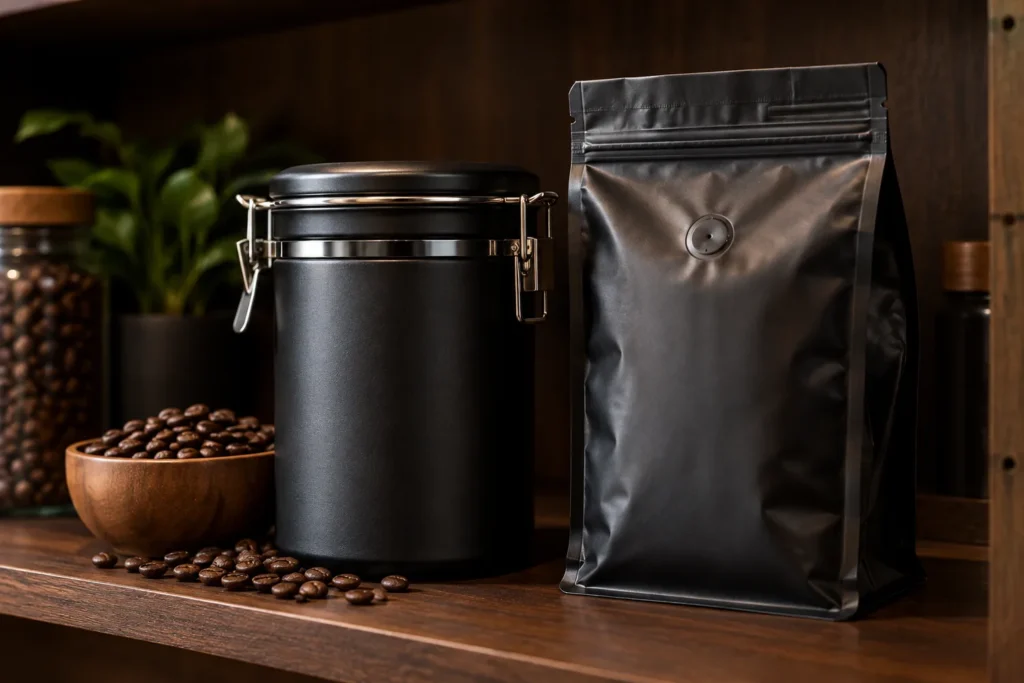
To store coffee beans well, keep them whole, sealed airtight, and away from heat, light and moisture. Store them in a cool, dark cupboard, not beside a machine or sunny window. Order only what you will use in a week or two, and use the oldest stock first. Whole beans can reasonably be called fresh for about three weeks after roasting.
Key takeaways
- Oxygen is widely seen as the main cause of staling, with moisture and heat adding to it (Specialty Coffee Association).
- Whole beans stay fresh for about three weeks after roasting; ground coffee for about an hour (Specialty Coffee Association).
- Singapore’s mean annual relative humidity is around 82%, so airtight coffee bean storage matters (Meteorological Service Singapore).
- Buy one to two weeks’ supply at a time, and freeze only in truly airtight packs (National Coffee Association USA).
- Avanti roasts once or twice a week and rests beans for at least 48 hours before dispatch (Avanti Espresso).
In this article
- How do you store coffee beans so they stay fresh?
- What makes roasted coffee beans go stale?
- Why does Singapore’s climate make storage harder?
- Which containers keep coffee beans fresh?
- Should you buy whole beans or ground coffee?
- Should you keep coffee beans in the fridge or freezer?
- What is the best way to store bulk coffee beans for a café?
- Worked example: how often should a café order beans?
- Coffee bean storage dos and don’ts
- What storage cannot fix
- Common mistakes
- Further reading
- Frequently Asked Questions
- Sources
How do you store coffee beans so they stay fresh?
The short answer is to slow down the reactions that make coffee stale. The Specialty Coffee Association (SCA) explains that roasted beans hold carbon dioxide. While that gas surrounds the beans, it keeps oxygen out. Once it escapes, oxygen-rich air moves in and off-flavours start to develop.
So good storage does three things. It limits contact with air. It keeps beans cool, dry and dark. And it makes sure beans are used before they pass their best.
What makes roasted coffee beans go stale?
The SCA’s literature review on coffee staling notes that many see oxygen as “the primary enemy of roasted coffee”. It cites research showing that cutting oxygen to 0.5% could extend shelf life by about 20 times. The same review notes that each 1% rise in oxygen raises the speed of degradation by about 10%.
Moisture matters too. The SCA review reports a general positive link between moisture and staling. Heat speeds things up: degassing of whole beans runs about 1.5 times faster for every 10°C rise.
Degassing is the release of carbon dioxide after roasting. The SCA says it happens quickly for the first 20 days, then slows sharply. This is why the first three weeks after roasting matter most.
Table 1: What makes coffee beans go stale
| Factor | What it does | Source |
| Oxygen | Reacts with aroma compounds once carbon dioxide escapes; the main driver of staling | Specialty Coffee Association |
| Moisture | Linked with faster staling; beans absorb moisture and odours | Specialty Coffee Association; National Coffee Association USA |
| Heat | Degassing runs about 1.5 times faster for every 10°C rise | Specialty Coffee Association |
| Light | Clear canisters let in light, which can harm taste | National Coffee Association USA |
| Grinding | Carbon dioxide lost over weeks in whole beans is lost in minutes | Specialty Coffee Association |
Why does Singapore’s climate make storage harder?
The Meteorological Service Singapore publishes long-term climate means for Changi from 1991 to 2020. The mean annual relative humidity is around 82%. The mean daily maximum humidity ranges from 93% to 96.5% across the months.
Temperatures stay warm all year. The 24-hour mean temperature ranges from 26.8°C to 28.6°C across the months. Mean daily maximums run from 30.5°C to 32.4°C.
In practice, an open bag on a café counter sits in warm, damp air every day of the year. The National Coffee Association USA (NCA) notes that freezing or chilling may help most in humid climates. Even so, airtight packing is the first line of defence.
Which containers keep coffee beans fresh?
If you are asking how you should store coffee beans to keep them fresh, start with the container. The NCA advises an airtight container kept in a dark, cool place. It warns against clear canisters because they let in light. It also says to avoid spots near an oven, a dishwasher or strong afternoon sun.
Many roasters pack beans in flexible bags with a degassing valve. The SCA review describes a small study of such bags. Bags that did not leak held 0% oxygen and over 40% carbon dioxide. However, half of the six bags tested leaked at the top seal. The lesson is simple: a valve only helps if the seal holds.
How you close an opened pack also matters. A Zurich University of Applied Sciences study compared storage methods after opening. A pack with a built-in screw cap kept beans freshest. Clip, tape and transfer-canister methods all lost freshness faster.
For a café, this points to two habits. Close every bag or tub fully after each use. And open only what you need for the next shift or day.
Should you buy whole beans or ground coffee?
Buy whole beans if you can grind on site. The SCA says the carbon dioxide that whole beans lose over weeks is lost within minutes after grinding. It suggests ground coffee might be considered fresh for only about an hour.
The SCA review adds that grinding raises porosity and surface area, which speeds staling. The NCA’s advice is to grind the amount you need right before brewing.
This is why most espresso bars pair whole beans with on-demand grinding. If you are choosing espresso beans in Singapore, the bean and the grinder work as a pair. See our range of commercial coffee grinders and our guide to espresso beans vs regular coffee beans.
Should you keep coffee beans in the fridge or freezer?
The NCA says experts disagree on chilling coffee. It explains that coffee absorbs moisture, odours and tastes, so any container must be truly airtight. If you freeze, take out about a week’s supply at a time. Return the rest before condensation forms.
The NCA’s guide gives these freshness windows for opened coffee in airtight containers.
Table 2: Freshness windows for opened coffee in airtight containers
| Storage | How long it stays fresh | Source |
| Whole beans, room temperature | 1 to 3 weeks | National Coffee Association USA |
| Whole beans, refrigerated | 2 weeks | National Coffee Association USA |
| Whole beans, frozen | 3 to 4 months | National Coffee Association USA |
| Ground coffee, room temperature | 1 to 2 weeks | National Coffee Association USA |
The fridge adds little time, and fridges hold strong food odours. The freezer has better evidence. A Penn State University study stored whole beans in a freezer or at room temperature for nine weeks. A panel of 48 coffee consumers then compared the aroma with freshly roasted beans.
For dark roasts, most panellists noticed very little difference between frozen and fresh beans. Room-temperature dark roasts smelled different. Lighter roasts changed less over the nine weeks in either condition. The researchers found no evidence in the literature for the common worry about condensation.
For a busy café, freezing is a backup, not a routine. It suits a surplus you cannot use within a few weeks.
What is the best way to store bulk coffee beans for a café?
Bulk storage is mostly about rotation. Here is a simple routine for a café or office pantry.
- Label on arrival. Write the delivery date on every bag, next to any roast or packing date.
- First in, first out. Shelve new stock behind older stock, so the oldest bag is always opened next.
- Portion the day. Open one bag per day or shift. Keep the rest sealed.
- Store cool and dark. Use a closed cupboard away from the espresso machine, dishwasher and windows.
- Keep the hopper light. Fill the grinder hopper with only what the next service needs.
- Order by usage. Base each order on what you actually used last week, not on storage space.
Order size is where storage starts. The NCA advises buying smaller batches of freshly roasted coffee, ideally a one- or two-week supply. Buying coffee beans wholesale in Singapore lets you set up recurring deliveries sized to that window. Our wholesale coffee supply includes blend selection and recurring deliveries for cafés, restaurants, hotels and offices.
Avanti roasts locally in Singapore once or twice a week. Beans then rest for at least 48 hours, ideally 5 to 7 days, before packing. Our FAQ on roasting and resting explains that coffee received within 2 to 8 days after roasting is fresh and ideal. Brewing within 24 hours of roasting is not recommended.
Worked example: how often should a café order beans?
This is an illustrative example. The usage figure is assumed, not taken from a real café.
A café uses 6 kg of espresso beans a week. It trades six days a week, so it uses about 1 kg a day. It buys beans in 1 kg bags.
- Freshness on arrival: Avanti’s FAQ says beans received 2 to 8 days after roasting are fresh and ideal. To be cautious, assume they arrive on day 8.
- Freshness limit: The SCA treats whole beans as fresh for about three weeks, or day 21.
- Weekly order of 6 kg: The last bag is opened about six days after arrival. That is around day 14, well inside the window.
- Fortnightly order of 12 kg: The last bag is opened about 13 days after arrival. That is around day 21, right at the limit.
- Monthly order of 24 kg: The last bags would be opened around day 35, past the window.
The weekly order keeps every bag inside the freshness window, with room to spare. It also matches the NCA’s one- to two-week guidance. A small buffer, such as one extra day’s supply, covers a busy weekend.
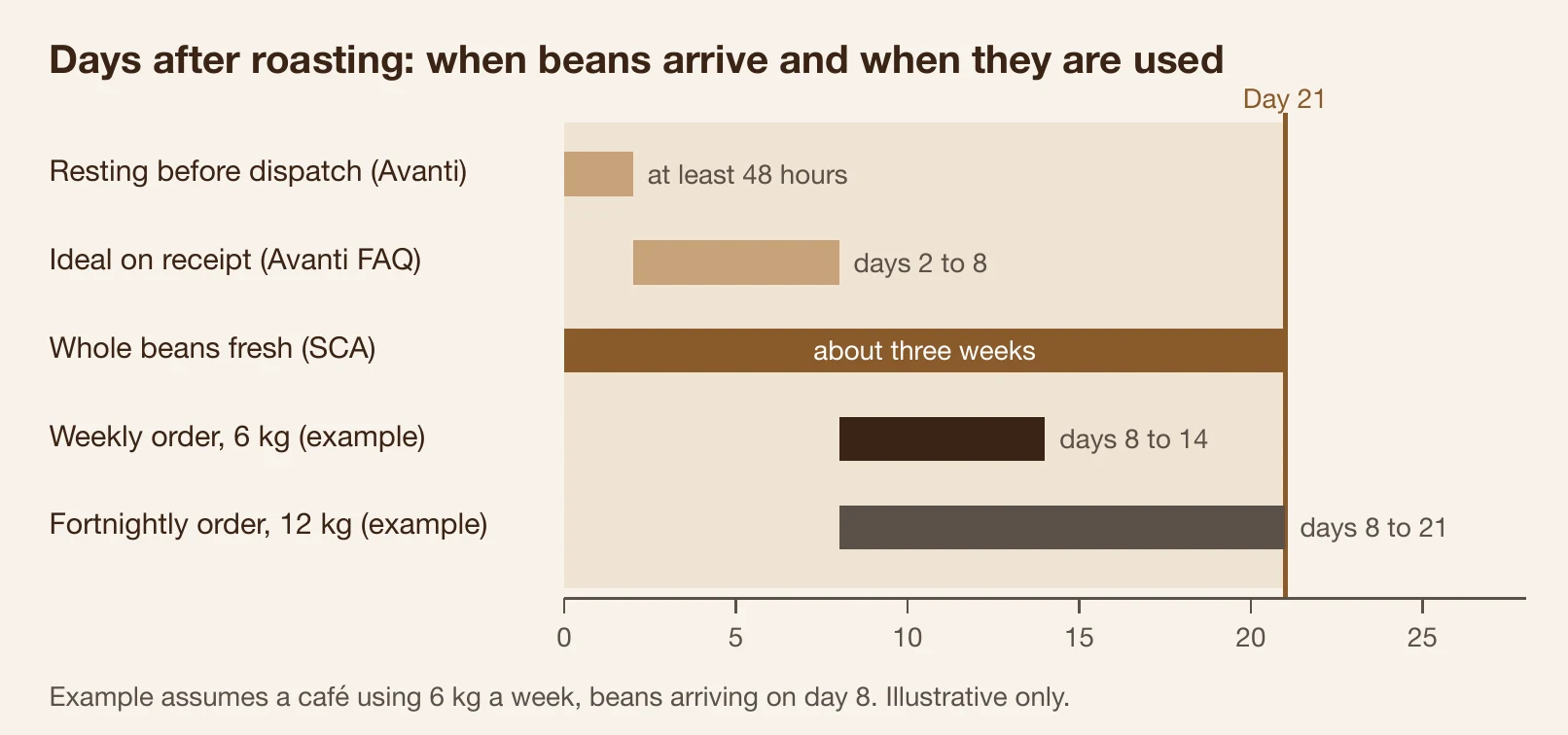
Figure 1: Days after roasting for weekly and fortnightly orders in the worked example, against Avanti’s arrival window and the SCA’s three-week freshness guide.
Coffee bean storage dos and don’ts
Table 3: Coffee bean storage dos and don’ts
| Do | Don’t |
| Keep beans whole until just before brewing | Grind a full day’s coffee in the morning |
| Use airtight, opaque containers or well-sealed bags | Display beans in clear jars on the counter |
| Store in a cool, dark cupboard | Shelve beans above the espresso machine or by a window |
| Order one to two weeks’ supply | Stockpile a month or more at room temperature |
| Use the oldest stock first | Top up the hopper with new beans over old ones |
| Freeze surplus in airtight packs, a week’s supply at a time | Move beans in and out of the freezer repeatedly |
What storage cannot fix
Storage only slows staling. It cannot bring back aroma that has already gone. Beans that arrive long after roasting will not improve on your shelf.
Storage also cannot fix a poor match between bean, grinder and recipe. If shots taste wrong with fresh beans, look at grind and dose first. Our guide to choosing commercial coffee beans and machines covers that side.
Finally, much of the research is limited. The SCA review notes that very few published studies compare specific packaging types. Treat these timings as guides.
Common mistakes
- Leaving the bag open between services. Every hour open lets more air reach the beans.
- Overfilling the grinder hopper. Beans left in the hopper sit warm and exposed.
- Using the fridge as a store. The NCA gives refrigerated beans only about two weeks, and coffee absorbs odours.
- Ordering by shelf space. A big order that lasts a month runs past the three-week window.
- Brewing beans the day they are roasted. Avanti’s FAQ advises against brewing within 24 hours of roasting.
- Mixing old and new beans. Topping up old beans with new ones blurs your rotation.
Further reading
- What to look for in a coffee beans supplier
- Choosing beans for espresso-based drinks
- Arabica vs Robusta: which espresso blend suits your café
- How to set up an office coffee programme
- Browse Avanti coffee beans, including Espresso Classico, Dolce Oro and Crema Oro
When you buy coffee beans in Singapore for a café or office, freshness starts with the order plan. Avanti roasts locally, rests every batch before dispatch and sets up recurring deliveries to match your weekly use. Tell us how much you brew each week, and we will help you plan a storage and delivery routine. Talk to our team
Frequently Asked Questions
How long do coffee beans stay fresh after roasting?
Whole beans can reasonably be considered fresh for about three weeks after roasting, according to the Specialty Coffee Association. Degassing is fastest in the first 20 days, then slows sharply. The National Coffee Association USA gives one to three weeks for opened whole beans at room temperature in an airtight container. Plan orders so each bag is used within that window.
Should I use coffee beans straight after roasting?
No. Avanti’s FAQ says brewing within 24 hours of roasting is not recommended, as the beans are still too fresh. Avanti rests beans for at least 48 hours, ideally 5 to 7 days, before packing. Coffee received within 2 to 8 days after roasting is considered fresh and ideal for use.
Is it better to store espresso beans in the freezer?
Only for surplus you cannot use within a few weeks. A Penn State University study found frozen dark-roast beans smelled close to fresh after nine weeks. The National Coffee Association USA says frozen beans keep three to four months if truly airtight. Take out about a week’s supply at a time, and return the rest quickly.
Can I keep coffee beans in the original bag?
Yes, if the bag seals well. A Zurich University of Applied Sciences study found a pack with a built-in screw cap kept opened beans freshest. Clip, tape and canister methods lost freshness faster. If your bag cannot be resealed firmly, the NCA advises an airtight, opaque container kept cool and dark.
How much coffee should an office order at a time?
Order about one to two weeks’ supply, as the National Coffee Association USA advises. Track how many bags the office uses each week, then set a recurring delivery to match. This keeps beans inside the three-week freshness window the Specialty Coffee Association describes. Store unopened bags in a cool cupboard, away from the pantry machine and windows.
Does ground coffee go stale faster than whole beans?
Yes, much faster. The Specialty Coffee Association says carbon dioxide that whole beans lose over weeks is lost within minutes of grinding. Ground coffee might be considered fresh for only about an hour. Grinding raises the surface area exposed to air. For the freshest cup, keep beans whole and grind just before brewing.